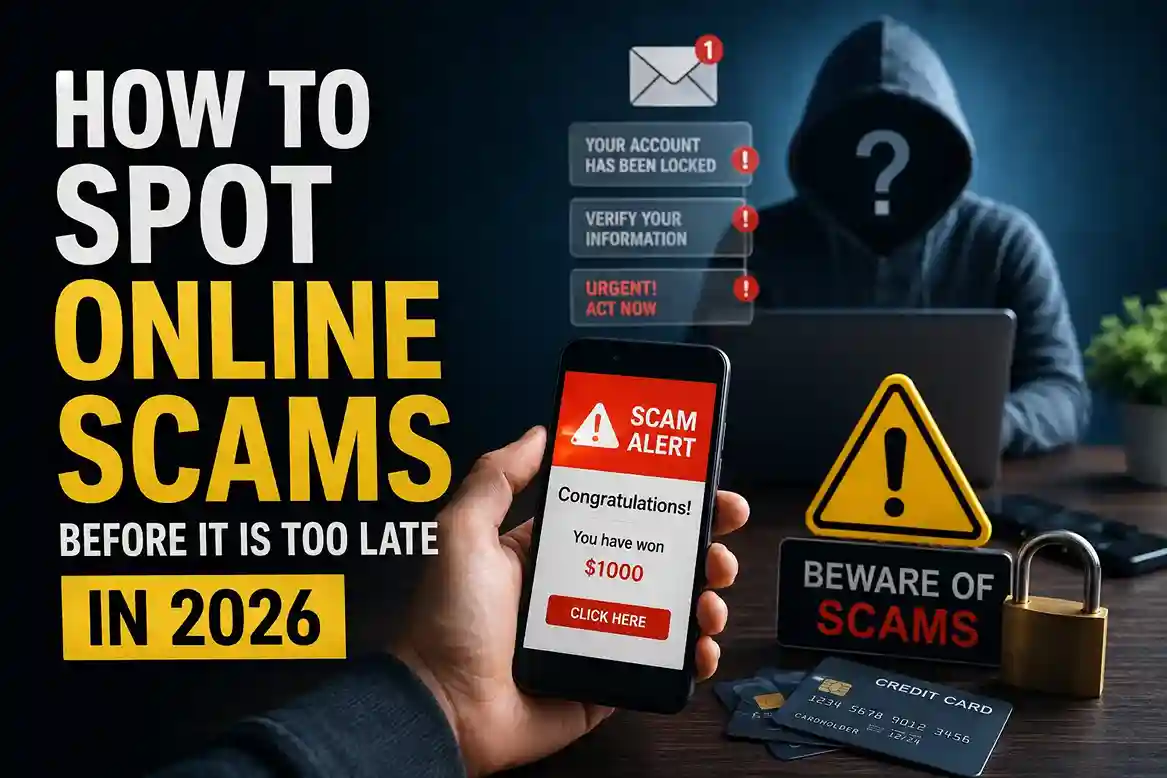
Online scams are no longer limited to obvious spam emails or badly written fake websites. In 2026, scammers use better design, AI-generated messages, cloned login pages, and urgent language to push people into acting fast. That is why how to spot online scams before it is too late in 2026 has become a practical skill, not just a tech topic. Readers who already pay attention to stronger privacy habits through How to Delete Your Personal Information From the Internet in 2026 and How to Strengthen Your Digital Privacy Habits in 2026 are usually easier to protect because they are more careful about what they click, share, and trust. The FTC also warns that scammers often try to create urgency and pressure people into sharing personal or financial information unexpectedly.
What makes modern scams dangerous is not just the message itself. It is the combination of timing, emotion, and believable details. A scam can arrive as a banking alert, a delivery update, a job opportunity, a customer-support chat, or even a phone call from someone who sounds official. In real-world situations, many victims do not ignore the warning signs because they are careless; they miss them because the scam looks normal at first glance. CISA explains that social engineering works by manipulating trust before the victim has time to verify the source.
How to Spot Online Scams Before It Is Too Late in 2026
The safest mindset is simple: slow down, verify independently, and never treat urgency as proof. Scammers want a fast reaction. Careful users give them the opposite. If you already follow habits from How to Check If a Website Is Safe Before Entering Personal Details in 2026, you already understand the basic idea: trust should be earned, not assumed.
1. Watch for pressure to act immediately
Most scams begin with a sense of urgency. The message may say your account will be suspended, your payment failed, your package is delayed, or your prize expires today. That pressure is not accidental. It is designed to stop you from thinking carefully. The FTC advises consumers not to respond to unexpected requests for personal or financial information, and the FBI’s fraud guidance also highlights common schemes that rely on deception and pressure.
A practical rule helps here: if a message wants instant action, pause first. Then verify through an official app, a saved bookmark, or a known phone number.
2. Check the sender, domain, and link destination
Scammers often hide behind small spelling changes. A fake domain may replace a letter, add a dash, or use a strange subdomain that looks official at a quick glance. This matters because many people trust the display name and ignore the actual address. That mistake is especially common in fake banking, delivery, and subscription messages. Google Safe Browsing exists because dangerous pages and downloads are a real and ongoing threat to users across the web.
A good habit is to hover over links before clicking them on desktop, and to long-press or inspect links on mobile. If the destination looks odd, do not continue.
3. Be suspicious of emotional manipulation
Scams are not always technical. Many are psychological. They may trigger fear, greed, sympathy, curiosity, or embarrassment. A message saying a family member is in trouble, a recruiter is impressed with your profile, or a seller has a once-in-a-lifetime deal can work because it makes you act emotionally. That is why articles like How to Protect Your Parents From AI Phone Scams in 2026 matter so much: fake urgency works even better when voice cloning and convincing scripts are involved.
In many real-world situations, the scam works because the story feels emotionally believable, not because the technical setup is sophisticated.
4. Compare the message with the official channel
One of the most effective ways to spot online scams before it is too late in 2026 is to stop trusting the message itself and confirm the claim somewhere else. For example, if a bank message says your account is locked, open the bank’s official app directly instead of tapping the link in the message. If a delivery notice seems suspicious, visit the courier’s site manually. If a recruiter contacts you, verify the company and the person independently, especially if the offer appears unusually easy.
That same verification mindset also helps in job-related fraud. Readers who have studied How to Spot Job Scams and Fake Recruiter Messages in 2026 know that legitimate employers do not usually rush people into sharing identity documents, payment details, or login credentials. The FBI continues to warn consumers about common fraud schemes that target personal data, money, and trust.
Common scam patterns people should recognize
Many scams repeat the same structure even when the topic changes. Once you learn the pattern, the disguise becomes easier to see.
Fake account alerts
These messages claim there is a login problem, suspicious activity, or a billing issue. They often send users to a fake login page. If your email security is already strong, as explained in How to Protect Your Email Account From Hackers in 2026, you are less likely to be trapped by these fake alerts because you will be used to checking recovery settings, MFA prompts, and unfamiliar sign-in notices.
Fake shopping or delivery messages
These scams pretend an order is delayed, a package is waiting, or a refund is available. The goal is to steal payment details or push the victim to install malware. The FBI specifically warns consumers about common fraud schemes including non-delivery scams and related online fraud patterns.
Fake support messages
Sometimes the scammer pretends to be tech support, a bank representative, or a service agent. The fake agent may ask to “verify” your identity, install software, or share a one-time password. That is a major red flag. Honest support teams do not normally ask for sensitive access in that way. The FTC’s phishing guidance and scam guidance both stress that unexpected contact asking for personal information should be treated carefully.
Fake job offers
Scammers know job seekers are often under pressure, so they create convincing recruiter messages, remote-work offers, and interview requests. A polished message is not proof of legitimacy. If you are exploring money-related decisions too, related articles such as Common Online Banking Scams and How to Avoid Them in 2026 can help you see how fraud techniques overlap across categories.
Best practices that reduce scam risk fast
Good scam prevention is usually about habits, not heroics. A few practical routines can cut risk sharply.
First, save official websites in bookmarks and use those bookmarks instead of searching again every time. Second, turn on multifactor authentication wherever possible. Third, keep devices, browsers, and apps updated. The FTC’s phishing guidance recommends using updated security tools and strong account protection, and CISA’s cybersecurity best practices also emphasize preventative measures.
Second, create a habit of checking before sharing. Ask yourself three questions every time: Who is contacting me? How do they want me to respond? What happens if I do nothing and verify first? In many real-world situations, that tiny pause is enough to stop a bad decision.
Third, review your important accounts regularly. If you already use a checklist like How to Create a Personal Cybersecurity Checklist in 2026, you are already ahead of most users because you are making scam defense a routine instead of a reaction.
What to do if you already clicked or replied
If you think you interacted with a scam, act quickly.
Change the password for the affected account immediately, then change any other account that reused the same password. Turn on multifactor authentication if it is not already enabled. Review bank or payment activity. If you shared card details, contact the financial institution right away. If you installed software or gave remote access, disconnect the device and get professional help if needed.
The FTC advises people to respond quickly after suspected scam exposure and to report fraud through its consumer reporting channels. The FBI also encourages consumers to use its scams and safety resources when they encounter suspicious activity.
Why families should talk about scams together
Scam prevention works better when everyone in the household understands the basics. Parents may be targeted through phone calls or fake emergency stories, while children may be tricked through gaming, social apps, or fake giveaways. Families that set shared rules tend to handle problems better because nobody has to guess what to do under pressure. That is one reason How to Create a Family Online Safety Plan in 2026 fits naturally with this topic.
In real-world situations, one family member often spots the warning sign while another is already emotionally engaged. A shared verification rule can prevent a costly mistake.
Common mistakes people make
A lot of scam victims make the same few errors.
They trust urgency too quickly. They assume a logo means legitimacy. They use the same password everywhere. They reply before checking the sender. They believe a refund or prize message because they want it to be true. They also ignore browser warnings, even though Google Safe Browsing is designed to flag dangerous sites and downloads.
The most common mistake, though, is simple: people believe they can identify every scam at a glance. That is not realistic anymore. Modern scams are built to look normal. The stronger habit is to verify, not to guess.
Conclusion
Learning how to spot online scams before it is too late in 2026 comes down to one idea: never let urgency replace verification. Check the sender, inspect the link, confirm through official channels, and treat unexpected requests with caution. Scammers rely on speed, emotion, and confusion. Careful readers rely on proof. If you combine that mindset with stronger account habits, safer browsing, and practical guides like How to Create a Personal Cybersecurity Checklist in 2026, How to Protect Your Email Account From Hackers in 2026, and How to Check If a Website Is Safe Before Entering Personal Details in 2026, you dramatically reduce your chances of becoming a victim. The FTC, CISA, FBI, and Google all point in the same direction: slow down, verify, and do not trust unexpected pressure.
FAQ
How can I spot online scams before it is too late in 2026?
Look for urgency, unusual links, emotional pressure, requests for personal data, and messages that push you to act before verifying independently. The safest approach is to confirm through an official app or bookmarked site.
Is HTTPS enough to trust a website?
No. HTTPS means the connection is encrypted, but it does not prove the site is legitimate. Scam sites can still use HTTPS.
What is the biggest warning sign of a scam?
Unexpected pressure. If a message creates fear or urgency and asks for money, passwords, or personal details, treat it as suspicious until you verify it independently.
What should I do if I already gave information to a scammer?
Change passwords, enable two-factor authentication, monitor accounts, contact your bank if needed, and report the incident through official fraud-reporting channels.
Can smart people still fall for scams?
Yes. Scams often work because they exploit emotion, urgency, and trust, not because the victim is careless or uninformed.

Shiva S writes about AI, cybersecurity, online safety, Google Discover, and digital trends. His focus is creating practical, easy-to-understand guides that help readers stay informed and safer online.