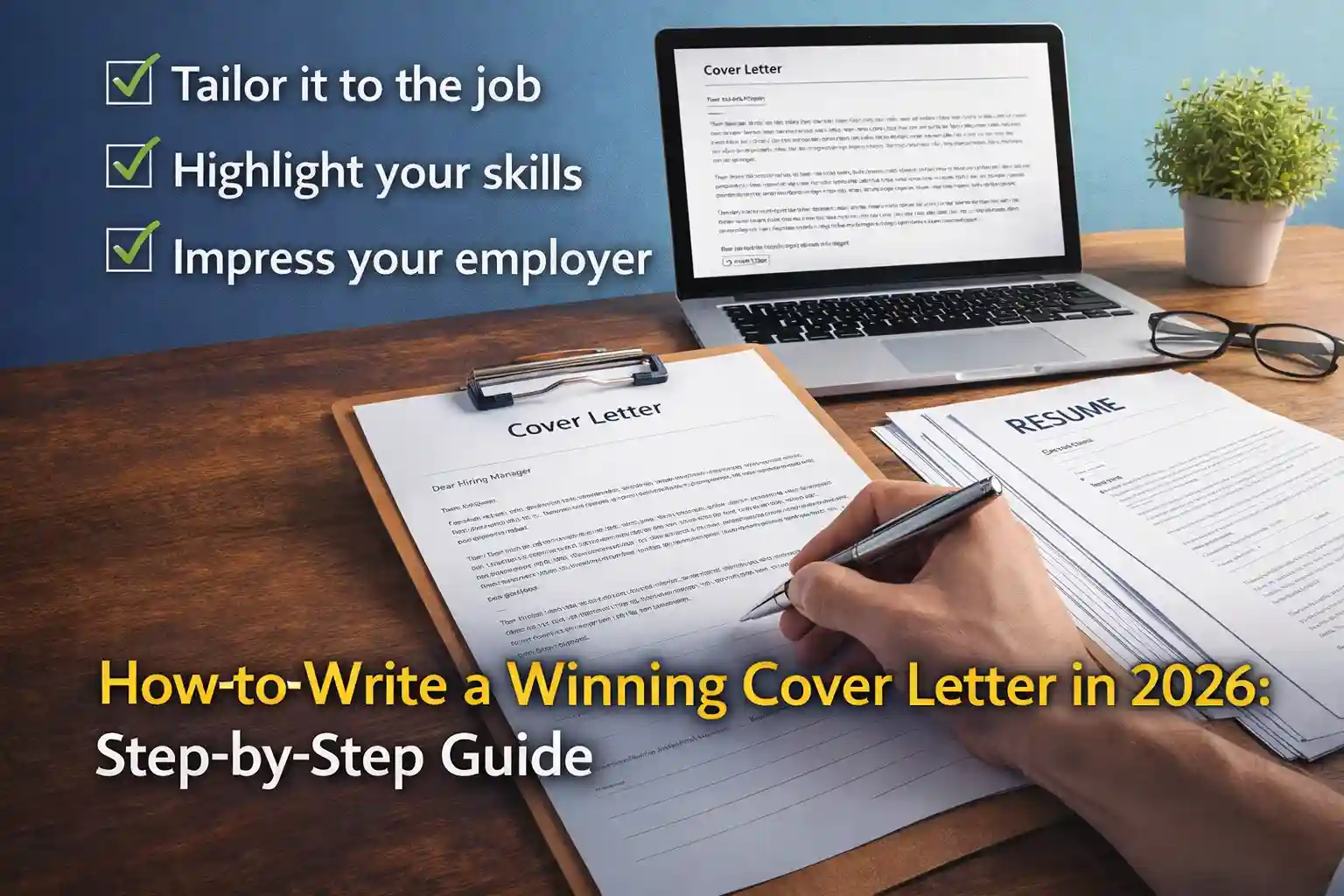
A strong cover letter still matters in 2026 because it gives you a chance to explain why you fit the role, why you care about the organization, and why the employer should keep reading. CareerOneStop says a cover letter is a good idea when you want to highlight your match to the job, explain employment gaps or issues, or show special interest in the role, and Harvard notes that your cover letter should introduce your qualifications and interest in both the job and organization.
This guide explains how to write a winning cover letter in 2026 step by step, with practical examples, simple structure, and a focus on what actually helps freshers get noticed.
Why a cover letter still matters
A resume tells the employer what you have done. A cover letter tells them why those experiences matter for this specific role. Harvard describes the cover letter as a narrative that accompanies your resume, and LinkedIn’s career guidance says it should not just restate your resume but should explain why your skills and qualifications make you a strong fit for the posting.
That difference is important. Many candidates send the same resume everywhere and never explain why they want the job. A thoughtful cover letter closes that gap. It gives the recruiter a reason to believe you applied with purpose rather than by accident.
For a site like latestnewss.com, this fits well with the existing resume content because the resume guide and cover-letter guide work together as a job-search cluster. Readers who are still building their applications can also benefit from the finance posts mentioned earlier because job readiness often depends on both career planning and money planning.
Step 1: Read the job description carefully
Before you write anything, study the job post. Look for the exact role title, required skills, preferred tools, and the tone of the company. CareerOneStop’s cover letter examples begin by stating the job you are applying for and mentioning what especially interests you about it, which shows how important the job description is from the very first line.
This step matters because every strong cover letter is built around one specific opportunity. If the post asks for communication skills, research ability, or teamwork, those should appear naturally in your letter. If the company emphasizes customer support, project coordination, or content writing, your letter should reflect that language without sounding copied.
A common mistake is writing a “general” cover letter that could apply to any job. That kind of letter usually gets ignored because it does not show effort. Your goal is to prove relevance, not volume.
Step 2: Choose one main angle for your letter
A cover letter gets stronger when it has a clear angle. You do not need to mention everything you have ever done. You only need to choose the most relevant proof for the role.
For a fresher, the angle might be:
academic projects,
internships,
transferable skills,
volunteer work,
or a strong personal interest in the field.
For someone changing careers, the angle might be transferable experience and a clear reason for the switch. CareerOneStop specifically says a cover letter can help explain gaps or issues, while Harvard says to focus on your qualifications and interest in the organization.
That means your letter should answer one simple question: why should this employer care about you for this role? Once you know the answer, the writing becomes much easier.
Step 3: Use a clean structure
The easiest cover letters to read usually follow a simple pattern: opening paragraph, body paragraph or two, and a short closing. CareerOneStop’s sample guidance suggests beginning with the job title and why you are interested, while Harvard describes the letter as a short narrative that should clearly connect your skills to the employer’s needs.
A useful structure for 2026 looks like this:
First paragraph: state the role and your interest.
Second paragraph: show the most relevant experience or skills.
Third paragraph: connect your background to the company’s needs and close politely.
This simple structure works because recruiters do not want to dig through a messy letter. They want to see relevance quickly.
Step 4: Write an opening that sounds specific
The opening should not sound like a template. It should sound like a person who applied for a real job with a real reason.
Weak opening:
“I am writing to apply for the position in your organization.”
Better opening:
“I am excited to apply for the content executive role at your company because I enjoy creating clear, useful writing that helps readers understand complex topics.”
The second version works better because it is more direct and more specific. It shows role interest and a little personality without sounding overdone.
If you want a good model to follow, CareerOneStop’s sample cover letter guidance says the first paragraph should identify the job and mention how you learned of the opening or what interests you most about it.
Step 5: Show value, do not repeat your resume
This is where many cover letters go wrong. They simply rewrite the resume in paragraph form. Harvard specifically says a good cover letter should describe your qualifications and your interest in the job and organization, and LinkedIn’s guidance warns against using the letter just to restate the resume.
Instead of repeating, connect the dots.
For example, if your resume already says you studied commerce and used Excel in college projects, your cover letter can explain how that background helps you handle reporting, organization, or data entry in the role you want.
If you are building your career documents together, it can help to read How to Write a Resume That Gets Interviews first. The resume gives the facts. The cover letter adds the story. That is the practical relationship between the two pages.
Step 6: Add one short achievement or example
A winning cover letter usually includes one small but meaningful proof point. This could be an internship result, a college project, a leadership task, a volunteer activity, or a measurable outcome from any relevant experience.
Example:
“During my final-year project, I worked with a small team to organize research, present findings clearly, and submit the work before deadline. That experience helped me strengthen my communication, planning, and teamwork skills.”
That kind of sentence works because it is specific, believable, and relevant. It does not try to sound dramatic. It simply shows capability.
Harvard’s cover letter guidance says a response-producing cover letter should include the skills or experiences most applicable to the job or industry and should be tailored to the organization and position.
Step 7: Tailor every cover letter
This is the biggest difference between an average cover letter and a strong one. Tailoring means adjusting the language, example, and focus for each job. LinkedIn’s career guidance says to tailor the letter to the skills and qualifications listed in the job post, and Harvard says to keep the organization’s hiring needs in mind.
A tailored letter may sound like this:
For a marketing role, highlight communication, content, and audience understanding.
For an office role, highlight organization, accuracy, and coordination.
For a customer support role, highlight empathy, clear communication, and problem-solving.
For a content role, highlight writing, editing, research, and clarity.
Even if two jobs look similar, do not send the exact same letter. Small adjustments make a big difference.
Step 8: Keep the tone professional and human
A cover letter should sound confident, but not inflated. It should sound warm, but not casual. It should sound polished, but not robotic.
That balance matters because a cover letter is both a communication tool and a writing sample. Harvard’s guide says it is part of the screening process and a way to demonstrate writing skill, which means clarity, grammar, and tone all matter.
Avoid:
overly formal phrases,
too many buzzwords,
fake enthusiasm,
and long sentences that say very little.
Use simple language. A recruiter should be able to understand your point quickly. If the letter feels like it was written to impress a machine, it usually fails to impress a person.
Step 9: Use a closing that invites the next step
Your closing should be brief, polite, and confident. You do not need to beg. You do not need to oversell. You only need to end clearly.
Example:
“I would welcome the chance to discuss how my background and interest in this role can support your team. Thank you for your time and consideration.”
That ending works because it is respectful and forward-looking. It gives the recruiter a clear next step without sounding pushy.
Step 10: Proofread like the letter matters
A good cover letter can lose value quickly if it contains spelling mistakes, missing company names, wrong job titles, or awkward phrasing. Since the letter is a writing sample, every line should be checked carefully. Harvard’s guidance emphasizes that the cover letter is part of the screening process, which makes proofreading essential.
Read it out loud once. Check the company name twice. Check the job title three times. Then ask whether every paragraph adds value. If a sentence does not help you win the interview, remove it.
A simple cover letter template for freshers
Here is a practical example you can adapt:
Dear Hiring Manager,
I am excited to apply for the [Job Title] position at [Company Name]. I am particularly interested in this opportunity because I enjoy working in roles that require clear communication, attention to detail, and a willingness to learn.
During my studies, I completed projects that helped me build research, presentation, and teamwork skills. I also gained experience working with [tool/task/subject], which strengthened my ability to stay organized and manage responsibilities carefully.
What attracts me to your organization is [specific reason related to company, role, or values]. I believe my background, interest in the field, and willingness to contribute make me a strong fit for this role.
Thank you for considering my application. I would welcome the opportunity to discuss how I can contribute to your team.
Sincerely,
[Your Name]
This template is intentionally simple because simple often works better than overly fancy writing. CareerOneStop’s sample guidance and Harvard’s cover letter resources both support a focused, job-specific approach rather than a long or generic letter.
Real-world example for a fresher
Imagine a student applying for a digital marketing internship.
The cover letter could say:
“I am excited to apply for the digital marketing internship at your company because I want to build a career in online communication and audience growth. During college, I worked on a team project where I created short content pieces, helped organize presentation materials, and supported research on social media trends. That experience taught me how to work with deadlines, communicate clearly, and adapt quickly.”
That example works because it is direct, relevant, and believable. It does not pretend the candidate has ten years of experience. It shows potential, interest, and effort.
If the same student is also building broader career skills, Top 10 High-Income Skills You Can Learn Online in 2026 is a useful companion article because skill-building and application writing often happen together.
Frequently Asked Questions
1. Do I need a cover letter for every job?
CareerOneStop says a cover letter is a good idea when you want to highlight your match to the job, explain gaps or issues, or show special interest in the role. If a job post asks for one, you should include one.
2. Should a cover letter repeat my resume?
No. Harvard and LinkedIn both advise using the cover letter to describe your qualifications and interest in the role instead of simply repeating the resume.
3. What should be in the first paragraph?
CareerOneStop’s sample guidance says the opening should identify the job you are applying for and mention what interests you about it.
4. How can freshers write a strong cover letter with little experience?
Freshers can focus on education, academic projects, internships, volunteering, and transferable skills. Harvard’s guidance says to tailor the letter to the specific job and organization and to include the experiences most applicable to the role.
5. How long should a cover letter be?
The safest approach is to keep it concise, focused, and easy to read. CareerOneStop and Harvard both emphasize relevance and clarity over length.
6. Can I use the same cover letter for every application?
It is better not to. LinkedIn and Harvard both stress tailoring the letter to the job post and the company so the letter feels specific rather than recycled.
7. What is the biggest mistake to avoid?
The biggest mistake is writing a generic letter that only repeats the resume and does not explain why you are a fit for the role.
Final thoughts
How to write a winning cover letter in 2026 comes down to one idea: make the letter specific, relevant, and human. Start with the job, show the best proof, connect your background to the employer’s needs, and keep the tone professional. CareerOneStop, Harvard, and LinkedIn all point in the same direction: a strong cover letter is tailored, concise, and focused on fit.

Shiva S writes about AI, cybersecurity, online safety, Google Discover, and digital trends. His focus is creating practical, easy-to-understand guides that help readers stay informed and safer online.