A monthly budget is simply a plan for where your money should go before the month begins. The CFPB describes an emergency fund as cash reserved for unplanned expenses such as car repairs, home repairs, medical bills, or loss of income, and the FDIC says financial experts generally recommend keeping several months of living expenses in a federally insured product for emergencies. A budget helps make room for those goals while still covering rent, food, bills, and daily life.
This guide shows how to create a monthly budget that actually works in 2026, even if you have never followed one before. The idea is to keep it simple enough to use every month and flexible enough to survive real life.
Why a monthly budget matters
A budget is not about restriction. It is about control. When you know where your money is going, you can stop wondering why the account feels empty at the end of the month. That is the difference between reacting to money and directing it.
A good budget also helps you save for the future without feeling deprived. It gives every rupee or dollar a job. That might be rent, groceries, transport, debt repayment, emergency savings, investing, or a small amount for entertainment. The point is not perfection. The point is awareness and consistency.
Step 1: Start with your real monthly income
The first step in how to create a monthly budget that actually works in 2026 is to calculate your take-home income, not your gross salary. Use the amount that actually lands in your account after tax, deductions, and mandatory contributions.
If your income changes each month, use a conservative average from the last three to six months. Freelancers and commission-based workers should avoid budgeting from their best month. Use a realistic baseline instead.
Example: if you usually earn ₹52,000 to ₹58,000, build your budget around ₹52,000. That gives you a cushion instead of creating a false sense of comfort.
Step 2: List fixed expenses first
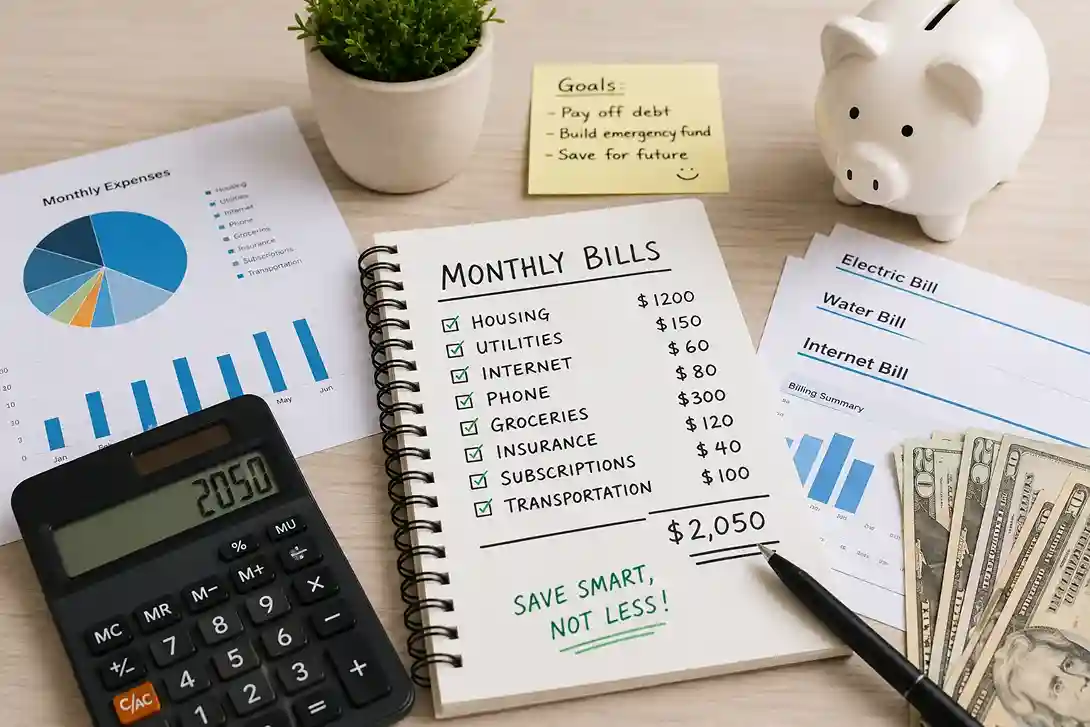
Fixed expenses are the bills you expect every month. These usually include:
Rent or home payment
Electricity and water
Internet and phone
Insurance
Subscriptions
Loan EMIs
School or tuition fees
Write these down first because they are harder to adjust quickly. Once you know your fixed costs, you can see how much is left for flexible spending. That makes the rest of the budget much easier to plan.
If you are already trying to strengthen your money habits, our article on Smart Personal Finance Habits That Can Make You Richer in 2026 fits well here because tracking fixed expenses is one of the most useful personal finance habits you can build.
Step 3: Separate needs, wants, and goals
One reason budgets fail is that everything gets mixed together. A useful budget should separate three categories:
Needs: rent, food, bills, transport, medicine
Wants: dining out, shopping, streaming, hobbies
Goals: emergency fund, debt repayment, investments, travel fund
This separation matters because it gives you clarity. A need is non-negotiable. A want is optional. A goal is future-focused. When you blur those lines, you spend too much on things that feel urgent but are not really priorities.
A simple target is to assign your income before the month begins. Even if your numbers are not perfect at first, the habit of assigning money in advance will improve your financial control over time.
Step 4: Use a budgeting method that matches your life
Many people have heard of the 50/30/20 rule. It can be a useful starting point:
50% for needs
30% for wants
20% for savings and debt reduction
But the best budget is the one you can actually follow. If your rent is high or your income is low, you may need a different ratio. A budget should fit your reality, not someone else’s formula.
The CFPB encourages building financial habits gradually, and the FDIC has also highlighted small, consistent steps as an effective way to build savings over time.
A practical version for beginners in 2026 might look like this:
60% needs
20% wants
20% goals
Or, if you are under pressure:
70% needs
15% wants
15% goals
The exact ratio matters less than the fact that you are deciding it on purpose.
Step 5: Build savings into the budget from the start
Do not wait to save “whatever is left.” That usually means saving nothing. A better budget treats savings as a fixed expense, just like rent or electricity.
This is where an emergency fund becomes essential. The CFPB says emergency savings are for unplanned expenses and financial emergencies, and the FDIC recommends keeping emergency savings in a separate FDIC-insured savings account so it is easier to resist everyday spending. If your emergency fund is still small, our guide on How to Build an Emergency Fund in 2026 is a helpful companion article.
A good rule is to move savings automatically the day income arrives. Even a small amount counts. For example, ₹2,000 a month becomes ₹24,000 in a year. That may not sound dramatic, but it can solve a real emergency when you need it most.
Step 6: Keep emergency money separate
One of the easiest ways to break a budget is to keep savings in the same account as spending money. The FDIC specifically recommends a separate FDIC-insured savings account for emergency savings so you are less tempted to spend it. The FDIC also says many financial experts recommend having at least six months of living expenses in a federally insured product for major income disruptions or unexpected repairs.
In practice, this means:
One account for salary or income
One account for spending
One separate account for emergency savings
That small separation creates a big mental difference. Money you can see is money you tend to use. Money that is separated is money you are more likely to protect.
Step 7: Track daily spending for one month
You do not need a complicated app to start. You only need to know where your money goes. Track every expense for 30 days and then review it honestly.
You will probably discover a few things:
Small purchases are bigger than they look.
Subscriptions add up quickly.
Food delivery can quietly distort your budget.
Weekend spending is often the hardest to control.
This is where a monthly budget becomes real. The numbers you write at the start of the month should match the way you actually live. If not, adjust the budget instead of pretending the problem does not exist.
If your spending is also affected by bigger financial trends, our article on Why Do Gold and Silver Prices Fluctuate Daily? is a reminder that markets move, but your budget should stay calm and steady.
Step 8: Make room for irregular expenses
A budget fails when it ignores yearly or irregular costs. Things like school fees, gifts, medical tests, annual subscriptions, car repairs, and travel do not happen every month, but they still need to be planned for.
The solution is simple: create sinking funds. A sinking fund is just money reserved for a future expense that you know is coming even if the timing is not monthly.
Example:
If you expect a ₹12,000 annual insurance payment, set aside ₹1,000 per month.
If you expect ₹24,000 in annual school costs, save ₹2,000 per month.
This keeps surprise expenses from destroying your budget.
Step 9: Review your budget every month
A monthly budget should never be static. Life changes, and your budget should change with it. Review the budget at the end of each month and ask three questions:
What went well?
What overspent?
What should change next month?
That monthly review is where progress happens. A budget becomes powerful when it is treated as a living system instead of a one-time worksheet.
If you are trying to improve your income side as well, the post How to Build Multiple Income Streams in 2026 is a good next read because growing income and controlling expenses work best together.
Step 10: Use a simple example budget
Here is a basic example for a monthly income of ₹50,000:
Needs:
Rent and bills: ₹22,000
Groceries and transport: ₹10,000
Insurance and loans: ₹5,000
Wants:
Eating out, entertainment, shopping: ₹6,000
Goals:
Emergency fund: ₹4,000
Investing or long-term savings: ₹3,000
Buffer:
₹0–₹2,000
That is only an example, but it shows the principle. Every rupee has a job. If your income is higher or lower, the categories stay the same even though the amounts change.
A budget like this becomes easier to follow when it is connected to a broader personal finance routine. Our earlier article Smart Personal Finance Habits That Can Make You Richer in 2026 covers the habits that make this kind of structure stick over time.
Common budgeting mistakes to avoid
The most common mistakes are simple but expensive:
budgeting from gross income instead of take-home pay,
forgetting irregular expenses,
making wants look like needs,
not saving automatically,
and giving up after one bad month.
Another common mistake is trying to make the budget too strict. A budget with no flexibility usually fails. Leave a little room for real life. A small buffer can keep one unexpected expense from ruining the whole plan.
User-intent FAQs
1. What is the easiest way to create a monthly budget?
Start with your take-home income, list fixed expenses, set savings first, and then divide the rest between wants and variable needs.
2. How much should I save each month?
There is no single number for everyone, but the FDIC says many experts recommend three to six months of living expenses for emergency savings, and the CFPB recommends starting in a way that is realistic and sustainable.
3. Should I use the 50/30/20 rule?
Yes, if it fits your situation. If not, use a ratio that matches your income, rent, and fixed costs. The best budget is the one you can actually follow.
4. What if my income changes every month?
Use your lowest realistic income from the last few months as the base and build a conservative budget around that number.
5. Is it better to save or pay debt first?
Do both if possible. Build at least a small emergency cushion while paying down high-interest debt, then increase savings once your budget is stable.
6. How often should I review my budget?
Once a month is a strong minimum. A monthly review helps you catch overspending before it becomes a pattern.
7. Where should I keep my emergency savings?
The FDIC recommends a separate FDIC-insured savings account so the money stays accessible but harder to spend casually.
Final thoughts
How to create a monthly budget that actually works in 2026 comes down to one idea: make your money plan realistic enough to follow every month. Start with income, cover your fixed costs, separate needs from wants, build savings into the plan, and review the numbers regularly. That simple structure is often more powerful than a complicated system you never use.

Shiva S writes about AI, cybersecurity, online safety, Google Discover, and digital trends. His focus is creating practical, easy-to-understand guides that help readers stay informed and safer online.