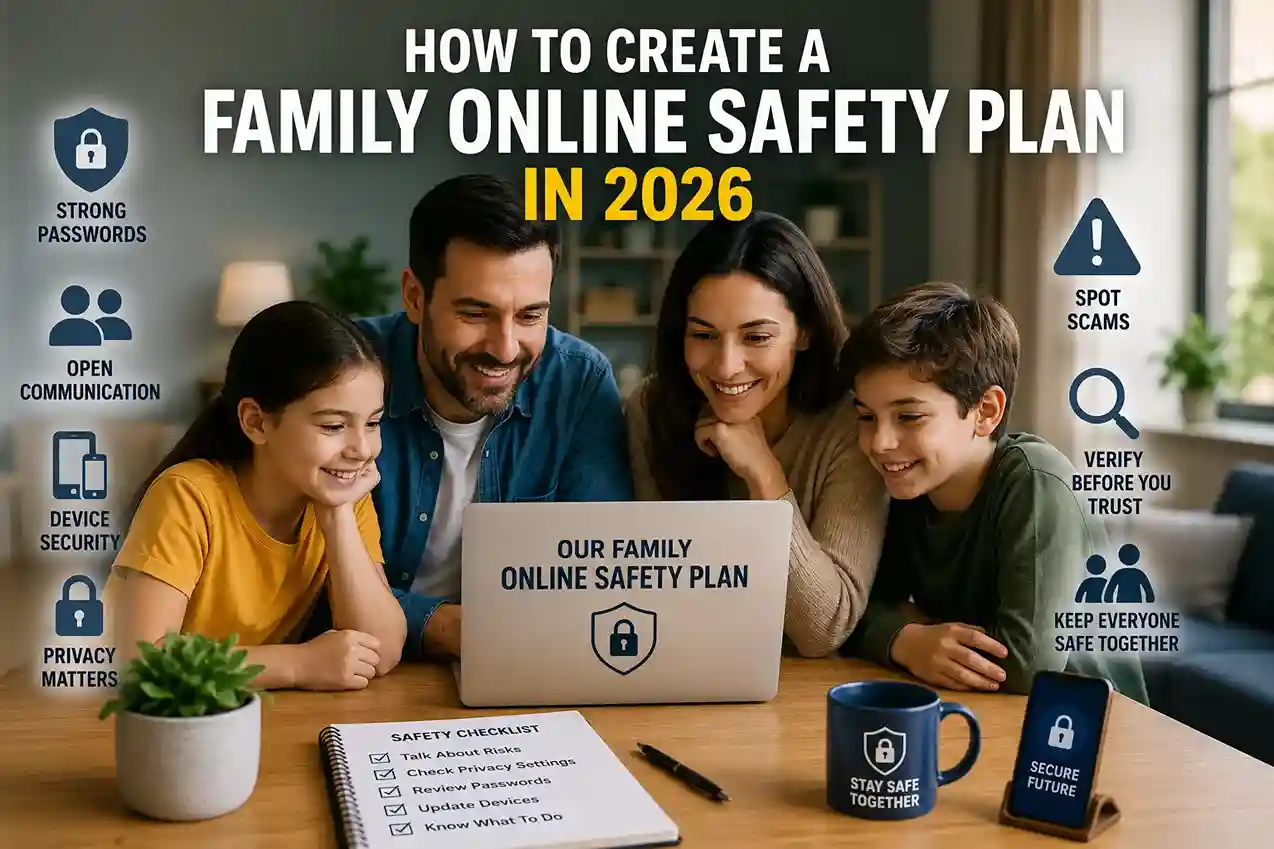
Learning how to create a family online safety plan in 2026 is becoming increasingly important because online scams, AI-generated fraud, fake emergency calls, and privacy risks now affect almost every household.
Today, internet safety is no longer only about protecting a computer. Families now manage:
- online banking,
- shopping apps,
- social media accounts,
- smart devices,
- AI-powered scams,
- and digital communication every day.
In many real-world situations, online problems happen because family members follow different safety habits. One person may recognize phishing emails immediately, while another may trust fake delivery messages or answer suspicious phone calls without verification.
A common mistake people make is assuming online safety only means using strong passwords. In reality, family safety also involves:
- scam awareness,
- verification routines,
- privacy habits,
- emergency communication plans,
- and knowing how to respond calmly under pressure.
Families already improving their digital awareness through guides like How to Protect Your Phone From Scam Calls, Fake OTPs, and Online Fraud are usually better prepared to recognize suspicious activity before reacting emotionally.
The FTC also warns consumers that scammers increasingly rely on urgency and emotional manipulation to pressure victims into fast decisions.
Source: https://consumer.ftc.gov/articles/how-avoid-scam
Why Every Family Needs an Online Safety Plan
A family online safety plan creates consistent rules for how everyone in the household responds to digital risks.
Without shared rules:
- people react emotionally,
- verification gets skipped,
- and scams become easier to succeed.
For example:
- one family member may click suspicious links,
- another may overshare personal information online,
- while someone else may trust AI-generated phone calls.
When everyone follows the same safety process, the household becomes much harder to target.
This verification-first mindset is similar to the approach discussed in How We Verify News Before Publishing, where information is checked carefully before action is taken.
The Cybersecurity & Infrastructure Security Agency (CISA) also emphasizes that many modern cyber threats rely heavily on human behavior and social engineering rather than only technical hacking.
Source: https://www.cisa.gov/news-events/news/avoiding-social-engineering-and-phishing-attacks
How to Create a Family Online Safety Plan in 2026
The best family online safety plans are simple, practical, and easy to remember.
Complicated rules usually fail because people stop following them consistently.
1. Identify the Biggest Risks in Your Household
Every family uses technology differently.
Some households are more exposed to:
- banking scams,
- fake OTP requests,
- phishing emails,
- or AI phone scams.
Others may worry more about:
- children using social media,
- fake videos,
- online gaming scams,
- or privacy risks.
A practical safety plan starts by identifying the situations your family encounters most often.
Families already using safer habits from How to Keep Your Personal Data Safe Online usually have an easier time recognizing which personal details should remain private.
2. Create Simple Family Safety Rules
The strongest online safety rules are easy to remember during stressful moments.
Examples include:
- Never share OTP codes.
- Never send money because of a phone call alone.
- Always verify urgent requests independently.
- Never install apps from suspicious links.
- Ask before posting family information publicly.
A common mistake people make is creating rules that are too technical or too complicated.
Simple rules work better because people remember them under pressure.
3. Build a Verification Routine
Every household should know exactly what to do when something suspicious happens.
For example:
- Pause before reacting.
- Read the message carefully.
- Verify through another trusted source.
- Ask another family member if unsure.
- Never act immediately under pressure.
This same “pause and verify” mindset also helps when evaluating misleading content online. Families who already read How to Verify an Image or Video Before Sharing It Online will recognize how emotional reactions often lead to mistakes.
The FBI Internet Crime Complaint Center (IC3) continues warning consumers that online scams frequently rely on emotional urgency and social engineering tactics.
Source: https://www.ic3.gov/
4. Create a Family Emergency Verification System
AI voice scams and fake emergency calls are becoming more realistic in 2026.
That is why families should create:
- a code word,
- emergency contact order,
- and verification process.
For example:
if someone claims a relative is injured or in danger, family members should:
- hang up,
- contact the person directly,
- and confirm independently before sending money.
This approach works especially well alongside the habits explained in How to Protect Your Parents From AI Phone Scams in 2026.
The FTC has specifically warned consumers about fake emergency scams and AI-generated impersonation calls targeting families.
Source: https://consumer.ftc.gov/articles/scammers-use-fake-emergencies-steal-your-money
Family Online Safety Rules That Actually Work
Practical habits usually matter more than advanced technical tools.
Rule 1: Never Trust Urgent Requests Immediately
Urgency is one of the most common scam tactics online.
Examples:
- “Act now.”
- “Your account will be suspended.”
- “Immediate payment required.”
- “Do not tell anyone.”
Scammers intentionally create panic because emotional pressure reduces critical thinking.
This psychological manipulation is explained further in How to Recognize Emotional Manipulation in Online Scams, where urgency and fear are used to influence decision-making.
Rule 2: Verify Before Sharing Information
Before sharing:
- passwords,
- OTP codes,
- bank details,
- addresses,
- or personal information,
verify who is requesting it.
A common mistake people make is assuming official-looking messages must be legitimate.
Modern scams often imitate:
- banks,
- delivery companies,
- tech support,
- or government agencies very convincingly.
Rule 3: Limit Oversharing on Social Media
Scammers often collect:
- birthdays,
- travel plans,
- school names,
- family photos,
- and voice clips
from social media profiles.
That information helps personalize scams.
Families already practicing the privacy habits discussed in How to Keep Your Personal Data Safe Online are much harder to target successfully.
Rule 4: Discuss Scams Openly at Home
Families that talk openly about scams are usually safer.
People should feel comfortable saying:
- “This message looks suspicious.”
- “Can someone verify this?”
- “I received a strange phone call.”
Open discussion reduces panic and improves faster decision-making.
Online Safety Tips for Children, Parents, and Grandparents
Different age groups face different online risks.
For Children
Teach children:
- not to click unknown links,
- not to talk to strangers online,
- and not to install apps without permission.
Parents should also explain why verification matters instead of only saying “don’t do that.”
For Parents
Parents often manage:
- online shopping,
- banking,
- email accounts,
- and family devices.
That makes them common scam targets.
A useful habit is slowing down before reacting to suspicious financial alerts or delivery messages.
For Grandparents and Older Adults
Older adults are frequently targeted through:
- fake emergency calls,
- impersonation scams,
- and AI-generated voice scams.
Families should practice:
- call verification,
- emergency code words,
- and safe callback habits regularly.
In many real-world situations, older adults respond emotionally because scammers create fear before logical thinking begins.
Why Emotional Awareness Matters Online
Modern scams increasingly rely on emotional manipulation instead of obvious technical tricks.
Scammers commonly use:
- fear,
- urgency,
- trust,
- excitement,
- or sympathy
to pressure people into impulsive decisions.
This is one reason why readers exploring Why Smart People Still Fall for Online Scams in 2026 often realize that intelligence alone does not prevent emotionally stressful mistakes.
Google also continues improving online scam detection systems because AI-generated fraud and impersonation attempts are increasing rapidly.
Source: https://blog.google/technology/safety-security/how-were-keeping-people-safe-online/
Create a Monthly Family Safety Check Routine
A family online safety plan should not be created once and forgotten.
A simple monthly review can help families:
- update passwords,
- review privacy settings,
- discuss new scam trends,
- and identify suspicious activity early.
Even a short 15-minute discussion can improve awareness significantly.
Families who regularly discuss:
- misinformation,
- fake content,
- and verification habits
are usually less vulnerable to emotional manipulation online.
This connects naturally with the habits discussed in How to Spot Fake News Before You Share It.
Common Family Online Safety Mistakes
Assuming One Person Handles Everything
Online safety works best when the entire household participates.
Ignoring Phone Scams
Many families focus only on emails and websites while underestimating scam calls.
Making Rules Too Complicated
Complicated rules are harder to follow consistently.
Simple routines work better.
Never Reviewing the Plan
Scam tactics evolve constantly.
A plan that worked last year may not fully address modern AI-powered scams.
Frequently Asked Questions
How do I create a family online safety plan in 2026?
Start by identifying your family’s biggest online risks, then create simple rules, verification habits, and emergency communication procedures everyone can follow.
What should a family online safety plan include?
It should include:
- scam prevention habits,
- password practices,
- verification routines,
- privacy guidelines,
- and emergency response steps.
Why are families increasingly targeted by scams?
Families often share personal information online, making impersonation and emotional manipulation easier for scammers.
How often should a family online safety plan be reviewed?
At least once per month or whenever new scam trends become common.
What is the most important online safety habit?
Pause before reacting emotionally and verify suspicious requests independently.
Can a family safety plan really reduce scam risks?
Yes. Families with shared safety habits are usually much harder for scammers to manipulate successfully.
Conclusion
Understanding how to create a family online safety plan in 2026 is becoming one of the most practical ways to reduce scam risks, emotional manipulation, and digital confusion at home.
The safest households are not necessarily the most technical.
They are usually the families that:
- communicate openly,
- verify suspicious activity,
- follow simple rules,
- and stay calm under pressure.
A good family safety plan does not need to be complicated.
It simply needs to be:
- clear,
- practical,
- and consistently followed.
For stronger digital awareness, also explore:
- How to Protect Your Parents From AI Phone Scams in 2026
- How to Recognize Emotional Manipulation in Online Scams
- Why Smart People Still Fall for Online Scams in 2026
Building safer online habits together is one of the best long-term protections any family can have..

Shiva S writes about AI, cybersecurity, online safety, Google Discover, and digital trends. His focus is creating practical, easy-to-understand guides that help readers stay informed and safer online.