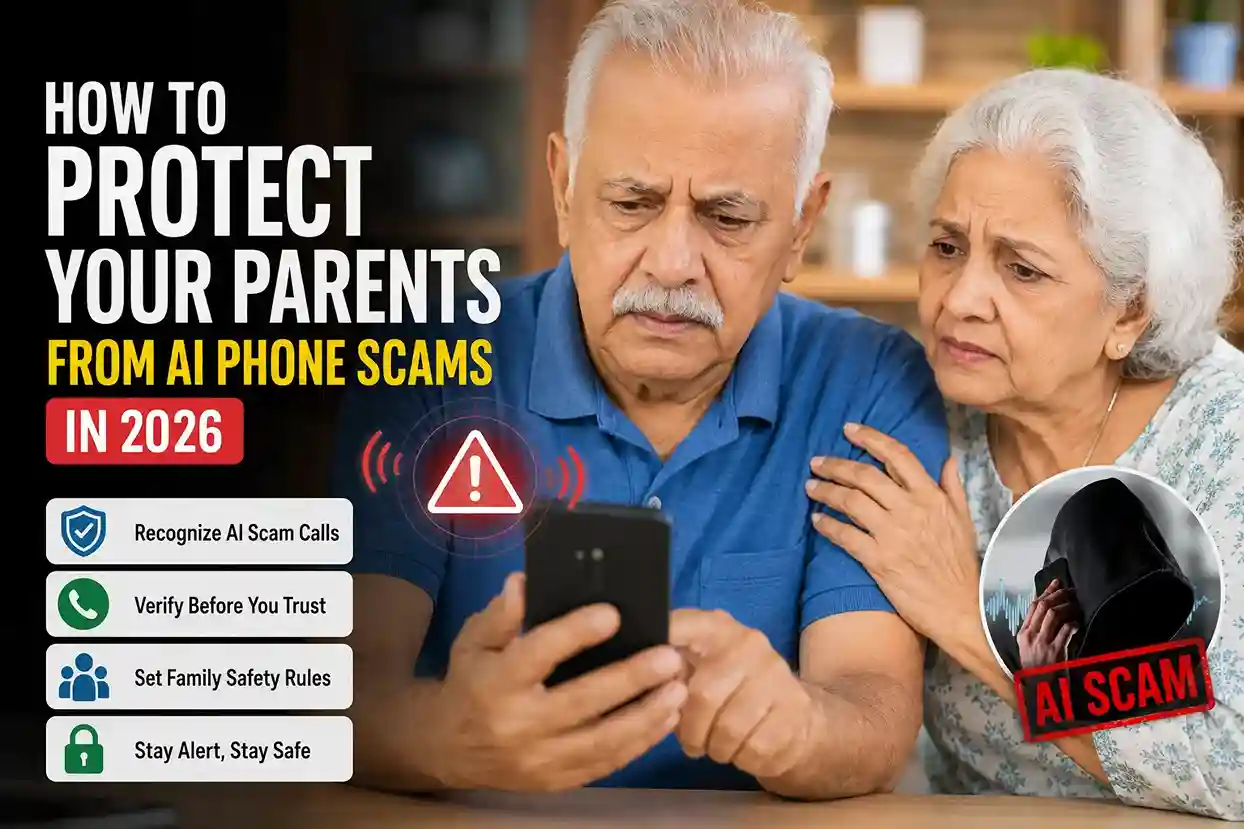
Learning how to protect your parents from AI phone scams in 2026 is becoming increasingly important because scammers now use artificial intelligence to imitate real voices, fake emergencies, and manipulate emotions during phone calls.
A few years ago, scam calls were easier to recognize. Today, AI-generated voice cloning can make a caller sound surprisingly similar to:
- a son or daughter,
- a grandchild,
- a bank representative,
- or even a doctor.
In many real-world situations, victims do not lose money because they are careless. They lose money because the call creates panic before they have time to think clearly.
This growing problem is closely connected to wider online safety concerns discussed in How to Protect Your Phone From Scam Calls, Fake OTPs, and Online Fraud, where scam prevention starts with slowing down and verifying suspicious activity before reacting emotionally.
The U.S. Federal Trade Commission (FTC) has also warned that AI voice cloning is increasingly being used in family emergency scams and impersonation fraud. According to the FTC, scammers may clone voices from short online audio clips and use them to pressure victims into sending money quickly.
Source: https://consumer.ftc.gov/consumer-alerts/2024/04/fighting-back-against-harmful-voice-cloning
Why AI Phone Scams Are Becoming More Dangerous
AI phone scams are growing because artificial intelligence tools are becoming:
- cheaper,
- faster,
- and easier to access.
Scammers no longer need advanced technical skills to create convincing fake audio.
A common mistake people make is assuming older adults will automatically recognize a fake voice. In reality, emotional pressure is what makes these scams dangerous.
For example:
- a caller may pretend to be a grandchild in danger,
- claim there was an accident,
- or say they urgently need money.
The emotional reaction often happens before logical thinking begins.
This emotional manipulation works similarly to misinformation campaigns discussed in How to Spot Fake News Before You Share It, where urgency and fear are commonly used to bypass careful thinking.
The Federal Communications Commission (FCC) has also warned that deepfake audio and AI-generated robocalls are becoming harder for consumers to identify.
Source: https://www.fcc.gov/consumers/guides/deep-fake-audio-and-video-links-make-robocalls-and-scam-texts-harder-spot
How to Protect Your Parents From AI Phone Scams
The best protection strategy is not complicated technology. It is a combination of:
- awareness,
- verification habits,
- and family communication.
1. Teach Parents to Verify Every Emergency Call
One of the safest habits is simple:
never trust urgent phone requests immediately.
If someone claims:
- there was an accident,
- an arrest,
- or an emergency,
your parents should:
- hang up,
- contact the real family member directly,
- verify through another trusted person.
This verification mindset is similar to the process explained in How to Verify an Image or Video Before Sharing It Online, where content should never be trusted at first glance.
2. Create a Family Code Word
A family code word is one of the most effective anti-scam protections.
Choose:
- a private phrase,
- nickname,
- or memory
that only close family members know.
If a suspicious caller claims to be a relative:
ask for the code word.
Most scammers will fail immediately.
In real-world situations, this simple habit often works better than complicated technical solutions.
3. Set a “No Immediate Money Transfer” Rule
Parents should never:
- wire money,
- buy gift cards,
- send cryptocurrency,
- or share OTP codes
because of a phone call alone.
The FTC specifically warns that fake emergency scams often pressure victims into fast payment methods because they are difficult to reverse later.
Source: https://consumer.ftc.gov/articles/scammers-use-fake-emergencies-steal-your-money
A common mistake people make is assuming:
“I’ll just send a small amount to help quickly.”
Unfortunately, even small payments confirm to scammers that the victim is vulnerable.
4. Limit Public Personal Information Online
Scammers often collect:
- family names,
- birthdays,
- voice clips,
- photos,
- and personal details
from social media accounts.
That information helps them create more believable scam calls.
Families already following safer privacy habits from How to Keep Your Personal Data Safe Online are usually much harder targets for AI scam attempts.
5. Slow the Conversation Down
Scammers rely heavily on panic and urgency.
Teach parents to use phrases like:
- “I need to verify this first.”
- “I will call you back.”
- “I need to speak with another family member.”
- “I do not make payments over the phone.”
Real emergencies can still be handled after verification.
A legitimate caller will rarely object to a short delay.
Common AI Phone Scam Tactics in 2026
Understanding scam tactics makes them easier to recognize.
Fake Grandchild Emergency Calls
This is one of the fastest-growing scams.
A caller pretends to be:
- a grandchild,
- son,
- or daughter
and claims there is:
- an accident,
- kidnapping,
- arrest,
- or medical emergency.
The voice sounds emotional and urgent.
Because AI voice cloning is improving rapidly, these calls can sound surprisingly convincing.
Fake Bank Security Calls
Scammers may pretend to be:
- bank employees,
- fraud investigators,
- or payment security teams.
They often request:
- OTP codes,
- account details,
- verification numbers,
- or money transfers.
This connects directly with the risks discussed in How to Protect Your Phone From Scam Calls, Fake OTPs, and Online Fraud.
Fake Hospital or Doctor Calls
Scammers may claim:
- a relative was injured,
- urgent surgery is needed,
- or medical payment is required immediately.
Fear is what makes these scams effective.
In real-world situations, emotional pressure is often stronger than technical deception.
Fake Government or Police Calls
Some scammers impersonate:
- police,
- tax departments,
- immigration officers,
- or legal authorities.
They may threaten:
- arrest,
- fines,
- account freezes,
- or legal action.
Legitimate government agencies rarely demand urgent payment through phone calls.
Warning Signs Parents Should Know
Even realistic AI scam calls often reveal subtle clues.
Watch for:
- extreme urgency,
- secrecy requests,
- pressure to act immediately,
- unusual payment methods,
- robotic pauses,
- strange speech timing,
- emotional manipulation.
A common mistake people make is focusing only on whether the voice sounds real.
The more important question is:
Does the situation itself make sense?
Practical Family Safety Habits
Families that openly discuss scams are usually much safer than families that avoid these conversations.
Practice Fake Scam Scenarios
A simple practice conversation can help parents stay calm during real scam attempts.
For example:
- simulate an emergency call,
- practice verification questions,
- rehearse hanging up safely.
This reduces panic during real situations.
Save Trusted Contacts Properly
Ensure important family numbers are:
- saved clearly,
- easy to find,
- and updated regularly.
This prevents confusion during stressful calls.
Use Spam Call Protection
Many phones and carriers now offer:
- spam filtering,
- scam call alerts,
- call screening features.
Google also continues improving scam detection and online safety systems across its products.
Source: https://blog.google/technology/safety-security/how-were-keeping-people-safe-online/
These tools are not perfect, but they help reduce exposure.
What To Do If Your Parent Already Shared Information
If a scam already happened:
act quickly but calmly.
Immediate Steps:
- End communication
- Contact the bank
- Change passwords
- Review transactions
- Enable account security alerts
- Inform close family members
- Report suspicious activity
Fast response can reduce financial damage significantly.
Why Digital Awareness Matters More in 2026
AI scams are becoming more believable because artificial intelligence tools continue improving rapidly.
That is why verification skills matter more than ever.
Readers already learning about:
- misinformation,
- AI-generated media,
- fake videos,
- and online verification
through articles like How We Verify News Before Publishing are already building safer online habits.
The goal is not paranoia.
The goal is:
thoughtful verification before reacting emotionally.
Frequently Asked Questions
How can I protect my parents from AI phone scams in 2026?
Teach them to verify emergency calls independently, use a family code word, avoid urgent money transfers, and slow conversations down before reacting.
Are AI voice scams really common now?
Yes. Organizations like the FTC and FCC have warned that AI-generated voice cloning is increasingly being used in scam calls and impersonation fraud.
What is the safest response to a suspicious emergency call?
Hang up and contact the family member directly using a trusted saved number.
Can AI clone someone’s voice from social media videos?
Yes. Even short voice clips may be enough for some AI cloning systems.
What payment methods do scammers usually request?
Common scam methods include:
- wire transfers,
- gift cards,
- cryptocurrency,
- payment apps,
- and bank transfers.
Why are older adults often targeted?
Scammers frequently target older adults because emotional pressure and trust-based manipulation are highly effective during urgent calls.
Conclusion
Understanding how to protect your parents from AI phone scams in 2026 is becoming an essential family safety skill.
AI-generated scam calls are more realistic than ever, but the most effective protection methods are still simple:
- pause,
- verify,
- slow down,
- and never send money impulsively.
Families who openly discuss scam tactics, verification habits, and emergency procedures are much less likely to become victims.

Shiva S writes about AI, cybersecurity, online safety, Google Discover, and digital trends. His focus is creating practical, easy-to-understand guides that help readers stay informed and safer online.