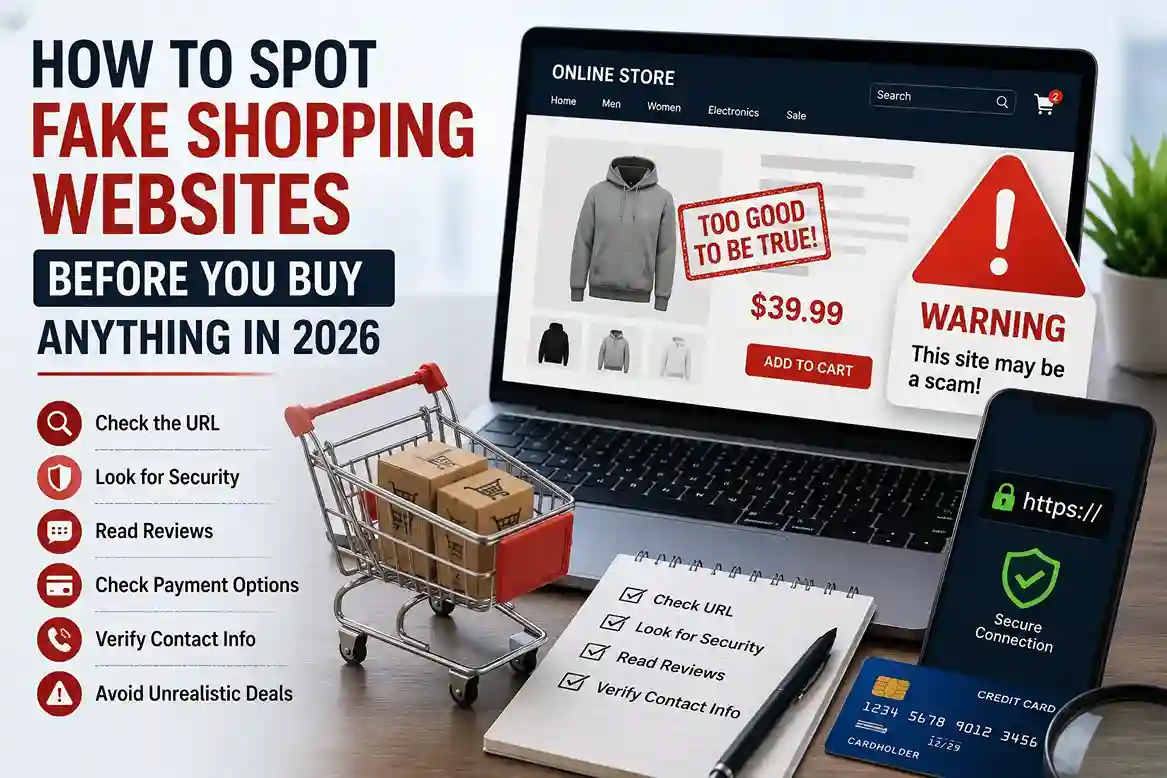
Fake shopping websites are getting harder to catch because they no longer look obviously fake. In 2026, many of them use polished product photos, copied brand layouts, fake reviews, and urgent discount messages to make buyers act quickly. That is why how to spot fake shopping websites before you buy anything in 2026 is now a practical skill, not just a cautionary tip. Readers who already follow safer habits from How to Check If a Website Is Safe Before Entering Personal Details in 2026 and How to Keep Your Personal Data Safe Online in 2026 are already ahead of the curve, because the same habits that protect personal data also help expose a fraudulent store. The FTC warns that scammers frequently use urgency and pressure to push people into sharing personal or financial information quickly.
The challenge is that fake stores often borrow just enough trust signals to feel legitimate. They may copy a real brand’s logo, publish a few believable product pages, and offer prices that seem almost too good to ignore. In real-world situations, people usually do not fall for these sites because they are careless. They fall for them because the site looks normal long enough to lower their guard. That is why the safest approach is to slow down and verify several things before you pay.
How to Spot Fake Shopping Websites Before You Buy Anything in 2026
The best way to spot a fake shopping website is to check for patterns, not just one warning sign. A single odd detail does not always mean the store is fraudulent, but several small problems together usually tell the truth.
1. Check the website address carefully
The URL is one of the first places fake stores slip up. A scam site may use a misspelled brand name, a strange subdomain, or a domain ending that does not match the business it claims to be. For example, a site that looks like a major retailer but uses a random extra word in the domain should make you pause.
This matters because attackers often build fake stores around urgency and trust manipulation, which is exactly the kind of behavior CISA warns about in social engineering and phishing attacks. Their guidance also emphasizes basic protections like thinking before clicking suspicious links and using security best practices.
If the shop name, domain name, and brand identity do not line up cleanly, treat that as a warning sign rather than a minor typo.
2. Look beyond the homepage design
A modern fake shopping website can look surprisingly polished on the surface. That is why design alone is not enough. Open the About page, return policy, shipping policy, and contact page. A real business usually explains who it is, how to reach support, and what happens if an order goes wrong.
That habit pairs well with How to Create a Personal Cybersecurity Checklist in 2026, because a checklist mindset helps you inspect the store before you trust it. If the site has vague company details, generic wording, or missing legal pages, do not ignore that. Scam sites often leave those pages thin because they are focused on collecting payments, not serving customers.
3. Judge the prices with healthy suspicion
Everyone loves a deal, but fake stores often use discounts that are unrealistically large. If a site claims to sell premium products at extreme markdowns with no real explanation, that is a classic red flag.
The FBI warns shoppers to be cautious with deals that seem too good to be true and notes that consumers should watch for common fraud patterns such as non-delivery scams and online shopping scams. If something looks far cheaper than every reputable retailer, compare prices elsewhere before you buy.
In many real-world situations, the scam works because the discount creates excitement before the buyer has time to verify the seller.
4. Read reviews, but do it the right way
Fake stores often post fake reviews, so the presence of reviews alone means nothing. What matters is whether those reviews look independent and believable. Repetitive praise, awkward wording, overly polished five-star comments, and review dates that all cluster together can be signs of manipulation.
A stronger approach is to search the store name outside the site and compare what other sources say. BBB Scam Tracker is a useful place to look up reported scam activity and suspicious business behavior, which can help you see whether other people have flagged the same site.
If a store claims it is widely trusted but you can find no independent proof, treat that as a warning rather than an oversight.
5. Check the product photos and descriptions
Fraudulent stores frequently steal product images from legitimate retailers or manufacturers. They may also use AI-edited or recycled images that look convincing at first glance. If the photos seem inconsistent, blurry, or identical across different products, that is worth investigating.
This is where a page like How to Verify an Image or Video Before Sharing It Online becomes surprisingly useful. The same habits apply here: zoom in, compare images across search results, and notice whether the seller is using original photos or borrowed ones. A store that cannot show its own products honestly may not ship anything at all.
6. Look at the payment options
Fake shopping websites often push buyers toward payment methods that are harder to reverse. If a store wants unusual payment methods, asks you to send money outside the checkout system, or avoids standard secure payment tools, be cautious.
The FTC says honest organizations will not unexpectedly ask for personal or financial information, and it advises people to use a website they know is trustworthy rather than clicking unfamiliar links in messages.
A legitimate store should make the checkout process feel routine, not secretive or pressured.
7. Verify the contact details before buying
A real business usually has a phone number, email address, or support form that works. Scam stores may list a contact page that looks complete but leads nowhere, or they may provide only a generic form with no real staff behind it.
If you are unsure, send a simple pre-sale question before ordering. Real businesses usually reply in a predictable way, while fake stores often never answer or reply with generic text. This is also one of the reasons readers who follow How to Protect Your Email Account From Hackers in 2026 tend to spot fraud faster: they are already used to treating unknown inbox messages with skepticism.
8. Watch for emotional pressure and urgency
Scam stores often use countdown timers, “limited stock” banners, and “buy now” language to force quick decisions. Those tactics are not always fraudulent by themselves, but they become suspicious when combined with weak contact information, vague policies, and strange payment requests.
If a website keeps pushing you to act before you can think, step back. In many cases, the pressure is the point. Readers who have studied How to Recognize Emotional Manipulation in Online Scams will recognize the pattern immediately: urgency is used to interrupt judgment.
9. Pay attention to browser and security warnings
Modern browsers and security tools can catch a lot of dangerous behavior before you do. Google Safe Browsing helps protect users by showing warnings when they try to visit dangerous sites or download dangerous files, and it identifies phishing and other web-based threats across Google products.
If your browser warns you, do not dismiss it just because the store looks attractive. A polished page can still be harmful. Search for the store independently and compare it with trusted sources before continuing.
10. Use your wider safety habits, not just one check
Spotting fake shopping websites gets much easier when it is part of a broader online safety routine. A guide like How to Stay Safe on Public Wi-Fi in 2026 matters because shopping on open networks can make weak sites even riskier. Likewise, How to Create a Family Online Safety Plan in 2026 helps households set a shared rule: verify first, pay later.
The FTC also recommends using multi-factor authentication, keeping software updated, and treating unexpected messages carefully. Those habits do not replace scam detection, but they make the damage much smaller if something slips through.
Common mistakes people make before buying
One of the biggest mistakes is assuming a professional-looking website must be legitimate. Another is trusting a huge discount because it feels like a lucky find. People also ignore mismatched branding, weak contact details, and copied product photos because they are focused on the bargain.
A smaller but important mistake is buying from a site after seeing only one positive clue, such as HTTPS or a clean design. Secure connection indicators matter, but they do not prove that a store is honest. Google Safe Browsing explains that users still need warnings and protections because dangerous and deceptive sites can look normal at first.
Best practices that actually protect you
If you want a simple buying routine, use this one:
- Check the URL carefully.
- Search the store name independently.
- Review the return and contact pages.
- Compare prices with reputable sellers.
- Inspect product photos for originality.
- Use a payment method that offers buyer protection.
- Avoid rushing because of countdown timers.
- Stop if the site demands unusual payment or personal details.
That routine is not complicated, but it works because it slows the moment when scammers try to rush you. It also fits naturally with How to Verify an Image or Video Before Sharing It Online and How to Check If a Website Is Safe Before Entering Personal Details in 2026, both of which reinforce the same habit: verify before you trust.
What to do if you already paid a fake store
If you realize after payment that a site may be fraudulent, act quickly. Contact your bank or card issuer, review pending charges, change any reused passwords, and watch your accounts for suspicious activity. If you used the same email and password combination elsewhere, update those accounts too.
The FTC and FBI both advise quick action when fraud is suspected, and the FBI recommends reporting online or internet-enabled crimes through its official fraud and scam channels as soon as possible.
Conclusion
Learning how to spot fake shopping websites before you buy anything in 2026 is mostly about slowing down, checking details, and refusing to let urgency make the decision for you. A fake store can copy a logo, borrow product photos, and dress up the checkout page, but it usually cannot hide all the warning signs at once. If you combine careful URL checks, independent reviews, smarter payment habits, and the safety routines you already use in How to Keep Your Personal Data Safe Online in 2026 and How to Create a Personal Cybersecurity Checklist in 2026, you will be far harder to fool. The FTC, CISA, Google Safe Browsing, the FBI, and BBB Scam Tracker all point in the same direction: pause, verify, and do not trust pressure.
FAQ
How can I tell if an online shop is fake before I buy?
Check the URL, contact page, return policy, reviews, product images, and payment methods. If the site feels rushed, vague, or inconsistent, be cautious.
Is HTTPS enough to trust a shopping website?
No. HTTPS only means the connection is encrypted. It does not prove the seller is real or the products are legitimate. Google Safe Browsing still warns users about dangerous sites even when they look normal.
What is the biggest red flag on fake shopping websites?
A combination of extreme discounts, poor contact details, copied photos, and pressure to buy immediately is one of the clearest warning patterns.
Should I trust customer reviews on a shopping site?
Not by themselves. Fake stores can publish fake reviews. Independent checks are much more useful than reviews shown only on the seller’s own site. BBB Scam Tracker can help you see whether others have reported problems.
What should I do if I already entered my card details?
Contact your bank or card issuer quickly, monitor transactions, change reused passwords, and secure your email and other connected accounts. The FTC recommends acting fast after suspected scam exposure.

Shiva S writes about AI, cybersecurity, online safety, Google Discover, and digital trends. His focus is creating practical, easy-to-understand guides that help readers stay informed and safer online.