Artificial intelligence can be impressively useful, but it is not automatically reliable. One minute it can summarize a topic in a way that feels polished and confident; the next, it can give a wrong date, a made-up source, or an answer that simply does not fit the real-world situation. That is why understanding what to do when AI gives wrong answers matters just as much as learning how to use AI in the first place. For anyone trying to understand how AI systems surface information, How AI Decides Search Results is a useful related read, especially if you want to see why an answer can look credible even when it is not.
Why AI gives wrong answers
AI does not “know” things in the human sense. It generates responses by finding patterns in data and predicting what sounds likely, which means a response can be fluent without being true. In practice, that can lead to outdated information, incomplete explanations, invented details, or answers that miss important context. NIST’s AI Risk Management Framework exists precisely because AI systems introduce risks that need to be identified, measured, and managed rather than blindly trusted.
In real-world situations, this shows up in small but costly ways. A student may get a citation that does not exist. A business owner may receive a summary that leaves out a major caveat. A shopper may get a product comparison that sounds reasonable but is based on stale information. CISA also warns that manipulated or inauthentic content can be used to mislead people, which is a reminder that the problem is not only “bad AI answers,” but also the broader information environment around them.
The first thing to do: slow down
The safest response is usually not to react immediately. Pause, read the answer carefully, and ask a simple question: does this sound plausible, or does it actually check out?
A good habit is to treat AI output as a draft, not a final authority. That means you can use it for brainstorming, outlining, and simplifying complex ideas, but you should verify any answer that affects money, health, legal decisions, or time-sensitive facts. The FTC’s scam guidance offers a similar principle for suspicious messages: do not accept pressure at face value, and do not hand over trust too quickly.
Check the answer against trusted sources
Once something looks questionable, compare it with a reliable source. That may mean looking at an official website, a government page, a company help center, or a reputable publication with a clear editorial process. For example, if AI tells you a policy changed, verify it on the organization’s official site. If it gives a safety tip, compare it against guidance from a trusted authority such as the FTC’s FTC scam prevention guidance or the FTC guide to recognizing phishing scams.
For AI-related risk management, the NIST AI Risk Management Framework is a strong reference point because it focuses on trustworthiness, risk, and evaluation rather than blind adoption. If your content or workflow depends on AI, that mindset matters. It is also why articles like Optimize Content for AI Overviews 2026 and How to Write Content for AI Search are useful companion reads for website owners who want to reduce confusion and improve clarity.
Ask AI to verify itself
A practical next step is to ask the system to show its reasoning, limitations, or sources. You can prompt it with phrases like:
- “Show me the source for that.”
- “What part of this answer is uncertain?”
- “What would make this answer wrong?”
- “Can you give me a second, more cautious version?”
This is especially helpful when the original answer sounds too smooth. In many cases, the issue is not malicious intent; it is overconfidence. A careful follow-up often reveals missing context, weak assumptions, or a guess presented as fact. That same caution is important when reviewing generated content for a site, which is why Update Old Blog Posts for AI Search 2026 can be useful for publishers trying to keep old pages accurate and useful.
Common mistakes people make
1. Trusting the first answer
The biggest mistake is assuming the first response is the final truth. AI is fast, not infallible.
2. Copying without checking
This is risky in school work, publishing, customer support, and business planning. A single wrong detail can damage credibility.
3. Using AI for sensitive decisions without human review
Anything involving money, medical choices, legal issues, or safety should be reviewed by a qualified person or an official source.
4. Ignoring date sensitivity
AI can sound current while quietly relying on older patterns. That is how outdated advice slips into planning, content, and purchasing decisions.
5. Confusing confidence with accuracy
A polished tone is not proof. AI often speaks with the same confidence whether it is right, partly right, or wrong.
FTC guidance around scams is useful here because it emphasizes caution around urgent, unexpected, or manipulative messages. The same mindset helps when AI gives an answer that feels too certain or too convenient.
Best practices for handling AI mistakes
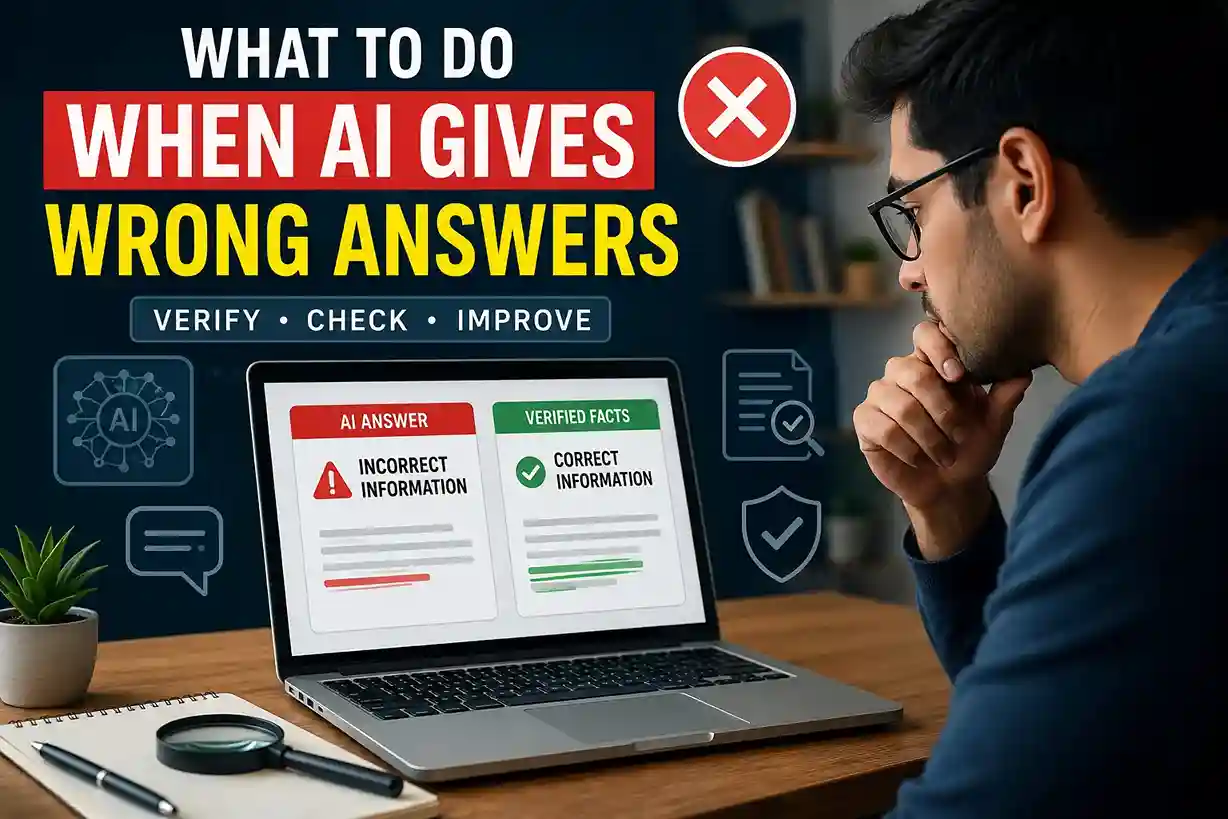
The best approach is to build a verification habit into your workflow. Start with the AI answer, then test it against a second source, then decide whether it is usable.
A simple process looks like this:
- Identify the claim that matters most.
- Check whether the claim is time-sensitive.
- Compare it with a trusted source.
- Revise or reject the AI answer if needed.
- Keep a note of the error so you do not repeat it.
For content teams, this is where topical cleanup matters too. A page like Why Website Is Not Showing in AI Answers can help explain why some content gets ignored, while Track AI Search Traffic Google Search Console 2026 helps you measure whether your corrections are actually improving visibility.
What to do if the answer is only partly wrong
Sometimes AI gets the core idea right but misses a detail. In those cases, do not throw everything away. Keep the useful part and correct the rest.
For example, if it gives a good explanation but names the wrong year, fix the year. If it summarizes a process well but skips a warning, add the warning. If it gives a source list with one weak or fake reference, remove that source and replace it with a trustworthy one.
That editing mindset is especially helpful for publishers. Articles about search visibility, such as FAQ Schema for AI Search Results 2026 and AI Overviews SEO 2026, can benefit from the same discipline: keep what is useful, remove what is unclear, and make the final result more trustworthy.
How to reduce wrong answers in the first place
You cannot eliminate AI errors completely, but you can reduce them.
Give the model more context. Ask for a narrower answer. Specify the country, year, audience, or format. Request uncertainty labels. Ask for sources. And when the topic is high-stakes, always cross-check with a human-reviewed source.
CISA’s materials on inauthentic content are also a helpful reminder that misleading information can be designed to look normal. In other words, the answer does not have to seem suspicious to be wrong. That is why verification should be a routine, not an afterthought.
In real-world situations, what should you do?
If you are a student, verify citations before submitting work.
If you are a professional, confirm any AI-generated recommendation before sending it to a client or manager.
If you are a website owner, audit pages that depend on accuracy and freshness, especially if you are working on topics tied to AI visibility and search. Posts like How AI Decides Search Results and How to Write Content for AI Search fit naturally into that broader strategy.
If you are a regular user, adopt one simple rule: when AI gives an answer that matters, verify it before acting on it. That habit alone can prevent a lot of avoidable mistakes.
FAQ: What to Do When AI Gives Wrong Answers
Why does AI sound so confident when it is wrong?
Because it is designed to generate the most likely response, not to guarantee truth. A fluent answer can still be inaccurate.
Should I stop using AI if it makes mistakes?
No. Use it with the right expectations. AI is useful for drafting, brainstorming, and simplifying, but important facts still need verification.
What is the safest way to check an AI answer?
Compare it with a trusted source, preferably an official one. For security and scam-related topics, FTC guidance is a strong reference point.
Can I trust AI for current information?
Only after checking. Time-sensitive topics are where AI is most likely to be wrong or outdated.
How do I train myself to spot mistakes faster?
Look for vague wording, missing sources, overconfident tone, and details that do not match official references. With practice, these warning signs become easier to catch.
Conclusion
Knowing what to do when AI gives wrong answers is part of using AI responsibly. The goal is not to fear the tool, but to use it with a better process: pause, verify, compare, correct, and only then rely on the result. That approach fits everything from personal decision-making to content publishing, and it aligns well with the risk-focused thinking encouraged by NIST, the caution emphasized by the FTC, and the misinformation awareness highlighted by CISA. For site owners, related guides like Track AI Search Traffic Google Search Console 2026 and Optimize Content for AI Overviews 2026 can help turn that verification habit into a stronger content strategy.

Shiva S writes about AI, cybersecurity, online safety, Google Discover, and digital trends. His focus is creating practical, easy-to-understand guides that help readers stay informed and safer online.