
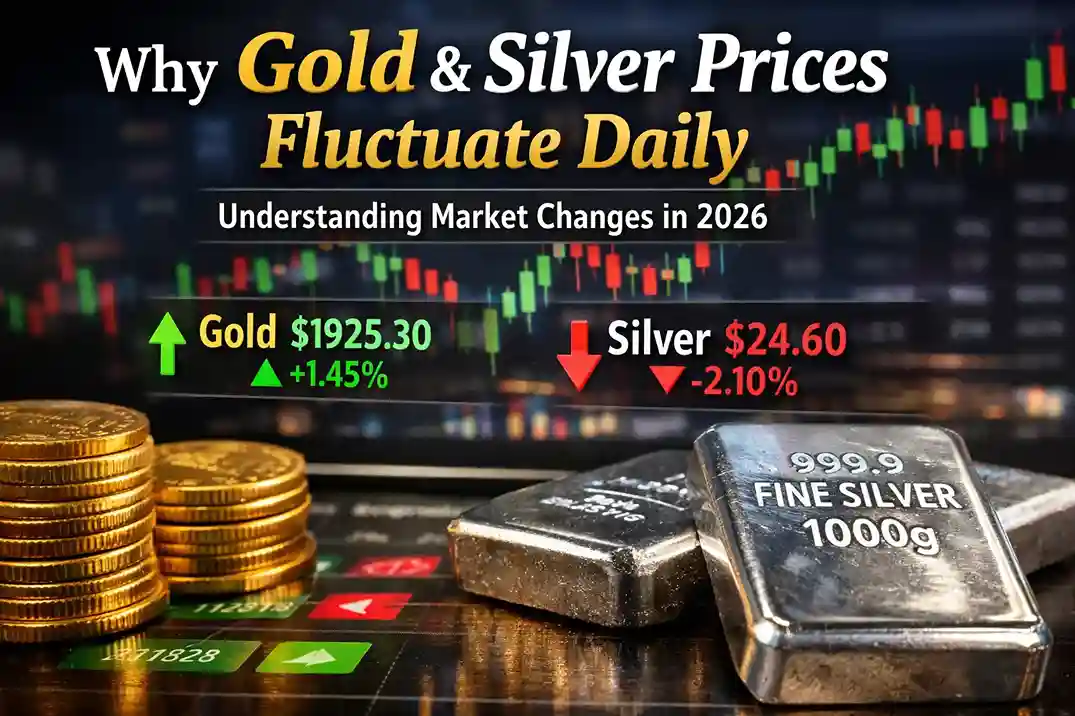
Gold and silver prices fluctuate daily because of changes in interest rates, inflation expectations, currency movements (especially the US dollar), central bank buying, global economic uncertainty, and supply-demand dynamics. Silver is generally more volatile than gold due to its strong industrial demand.
Introduction
Gold and silver are considered safe-haven assets, yet their prices move constantly — sometimes rising sharply within hours and other times falling unexpectedly.
If you’ve ever checked gold rates in the morning and noticed a different price by evening, you’re not alone.
Understanding why precious metal prices fluctuate helps investors, traders, and even jewellery buyers make smarter financial decisions.
In this article, we break down the real economic forces that drive gold and silver price movements in 2026.
Why Gold and Silver Prices Fluctuate Every Day in Global Markets
Gold and silver prices fluctuate continuously because they respond to real-time changes in global financial conditions. Unlike fixed-price commodities, precious metals are actively traded in international markets 24 hours a day.
The main reasons gold and silver prices fluctuate include:
- Changes in interest rates
- Inflation expectations
- US dollar strength or weakness
- Central bank buying or selling
- Industrial demand (especially for silver)
- Geopolitical uncertainty
- Futures market speculation
When any of these factors shift, even slightly, gold and silver prices react almost immediately.
For example, if inflation data is higher than expected, investors may rush to buy gold as a hedge — causing prices to spike within hours. On the other hand, if interest rates are increased, gold often sees short-term selling pressure.
This constant interaction between economic data, investor psychology, and global demand is the primary reason gold and silver prices never remain static.
How Economic News Makes Gold and Silver Prices Fluctuate Rapidly
Major economic announcements can cause sharp movements in precious metal prices within minutes.
These include:
- Central bank interest rate decisions
- Inflation reports
- Employment data
- Global recession fears
- Currency market swings
Because gold is considered a safe-haven asset, investors buy it during uncertainty. Silver, being both an investment and industrial metal, reacts even more dramatically during economic optimism or slowdown fears.
This is why on some days you may notice gold rising steadily while silver moves up or down more aggressively.
1. Interest Rates — The Biggest Driver
Gold does not pay interest. So when central banks like the Federal Reserve raise interest rates, investors often shift money into interest-bearing assets like bonds.
What happens?
- Higher interest rates → Gold becomes less attractive → Prices may fall
- Lower interest rates → Gold becomes more attractive → Prices often rise
Silver usually follows the same trend.
This is why central bank announcements can move gold prices within minutes. Interest rate decisions from the Federal Reserve often influence global gold prices within minutes of announcements.
2. Inflation Expectations
Gold is widely seen as a hedge against inflation.
When inflation rises:
- Currency loses purchasing power
- Investors buy gold to protect wealth
- Gold prices typically increase
For example, during periods of high global inflation, gold demand often spikes sharply.
Silver also benefits, but its industrial nature adds additional volatility. Understanding why gold and silver prices fluctuate is important for anyone building smart personal finance habits in 2026.
3. US Dollar Strength
Gold and silver are priced globally in US dollars.
When the US dollar strengthens:
- Gold becomes expensive for other countries
- Global demand may reduce
- Prices often decline
When the dollar weakens:
- Gold becomes cheaper internationally
- Demand increases
- Prices rise
This currency relationship is one of the most consistent factors influencing daily price movements.
4. Central Bank Buying and Selling
Central banks hold gold as part of their foreign reserves.
When central banks increase gold purchases:
- It creates strong demand
- Prices rise
When they sell reserves:
- Supply increases
- Prices may drop
In recent years, several countries have increased gold reserves to diversify away from currency risk. According to data from the World Gold Council, central bank gold purchases have played a major role in supporting long-term price trends.
5. Supply and Mining Production
Gold and silver are mined from the earth.
If mining output decreases:
- Supply tightens
- Prices rise
If new reserves are discovered:
- Supply increases
- Prices may stabilize or fall
However, mining changes are usually slow and affect long-term price trends rather than daily volatility.
6. Industrial Demand (Major Factor for Silver)
Silver has strong industrial usage in:
- Solar panels
- Electronics
- Electric vehicles
- Medical devices
When industrial production increases:
- Silver demand rises
- Prices spike
This makes silver more volatile compared to gold.
7. Geopolitical Uncertainty
During wars, global tensions, or economic crises:
- Investors seek safe assets
- Gold demand increases
- Prices often surge
This is why gold is often called a “crisis hedge.”
8. Futures Market & Trading Activity
Gold and silver prices are heavily influenced by futures trading.
Large institutional investors and hedge funds place high-volume trades that can move markets quickly.
Algorithmic trading also adds short-term volatility. Investors should also consider how precious metal investments are treated under the new income tax rules in 2026 before making long-term decisions.
Gold vs Silver: Why Silver Is More Volatile
| Factor | Gold | Silver |
|---|---|---|
| Safe Haven Demand | Strong | Moderate |
| Industrial Demand | Low | Very High |
| Market Size | Large | Smaller |
| Volatility Level | Moderate | High |
Because silver has both investment and industrial demand, it experiences sharper price swings.
Real-World Example (Recent Market Movement)
In early 2026, gold prices rose sharply as global investors reacted to interest rate expectations and inflation data. Silver followed but experienced larger percentage gains due to industrial optimism.
Such movements demonstrate how multiple factors combine to create volatility.
Should You Worry About Daily Price Changes?
For long-term investors:
- Daily fluctuations are normal
- Focus on long-term trend
For short-term traders:
- Monitor interest rate announcements
- Watch dollar movement
- Track global economic news
Understanding these factors reduces panic decisions. If you trade gold digitally, make sure you follow strong cybersecurity practices in 2026 to protect your financial data.
FAQs
1. Why do gold prices change every hour?
Gold prices change hourly due to live trading in global markets, interest rate news, currency fluctuations, and investor activity.
2. Is silver riskier than gold?
Yes, silver is generally more volatile because it is influenced by both investment demand and industrial demand.
3. Does inflation always increase gold prices?
Not always immediately, but sustained high inflation often increases gold demand over time.
4. What is the best time to buy gold?
There is no perfect time. Long-term investors often use systematic buying rather than timing the market.
5. Why does gold price differ between cities?
Local taxes, transportation costs, dealer margins, and currency fluctuations create regional price differences.
6. Why do gold and silver prices fluctuate so much in one day?
Gold and silver prices fluctuate within a single day due to live trading in global markets, investor reactions to economic data, currency changes, and futures market activity. Silver tends to fluctuate more because it is influenced by both investment demand and industrial demand.
Conclusion
Gold and silver prices fluctuate constantly because they respond to a complex combination of economic, financial, and geopolitical factors.
Interest rates, inflation, currency strength, industrial demand, and global uncertainty all play major roles.
For investors, understanding these drivers is more important than reacting to daily price changes.
Staying informed helps you make rational, confident decisions — whether you are buying jewellery, investing long term, or trading short term. Gold and silver can act as diversification tools alongside other strategies for building multiple income streams in 2026.
Author Note
Written by the LatestNewss Finance Desk — covering real-time economic insights, market analysis, and investment education.