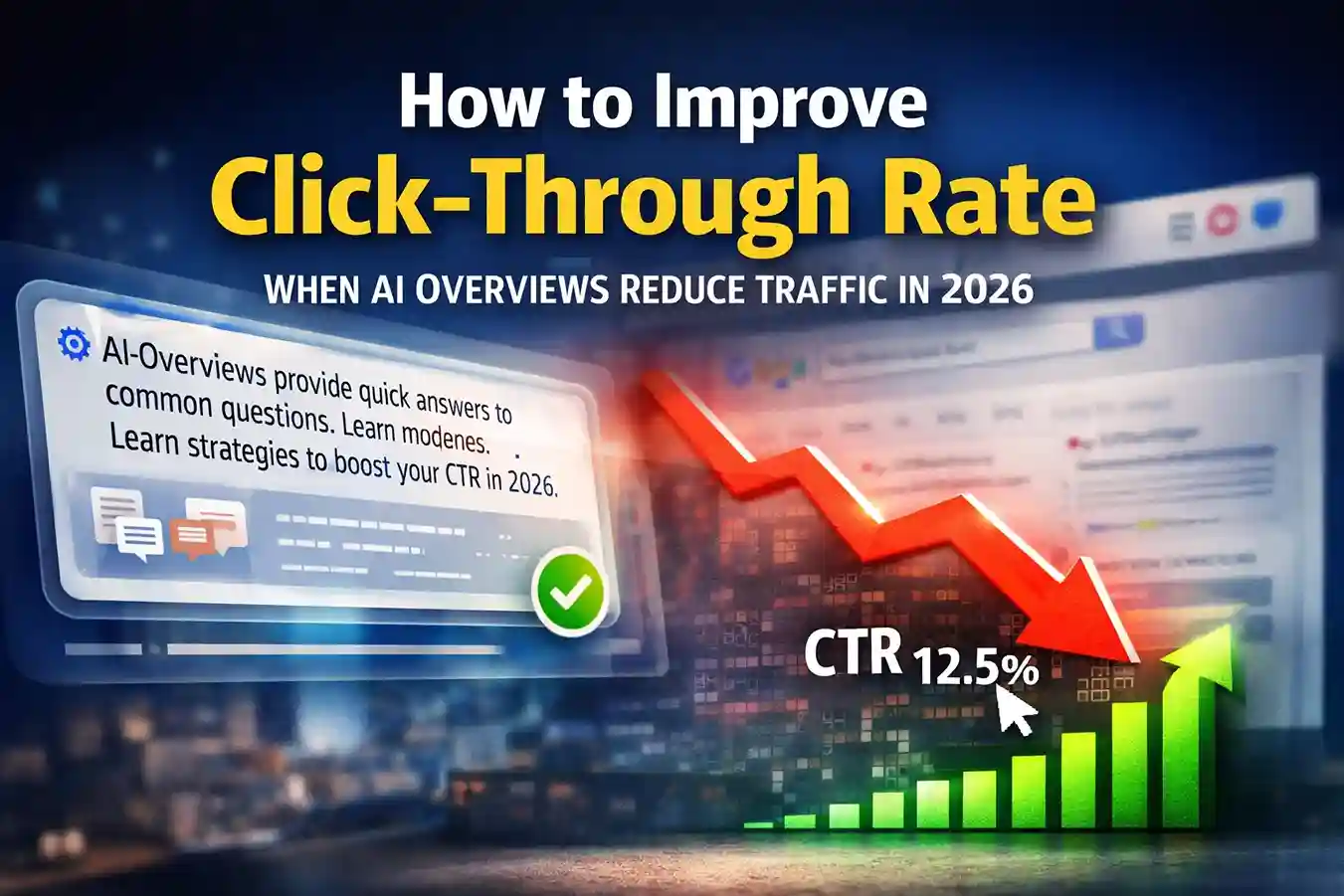
When AI Overviews reduce traffic, improving click-through rate becomes one of the most important SEO goals in 2026. Search results are changing quickly, and the old strategy of simply ranking on page one is no longer enough. Search engines now show more direct answers, summaries, and AI-generated explanations powered by advanced AI language models before users ever reach a website.
This shift is closely connected to how AI search results are evolving. Instead of showing only ten blue links, search engines now try to answer the query immediately. That is one of the main reasons AI zero-click searches are rising. Users often get the information they need through natural language processing systems without clicking into a page, which means even strong rankings can bring fewer visits than before.
For website owners, this creates a new challenge. If your impressions are holding steady but clicks are dropping, the problem may not be your ranking. The problem may be that your result is no longer the most clickable option on the page. That is why learning how to improve click-through rate in an AI-driven search environment is so important.
In this guide, you will learn why AI Overviews reduce traffic, what makes users click, and how to make your content more attractive in search results without sounding spammy or over-optimized.
Why AI Overviews Reduce Traffic
AI Overviews reduce traffic because they answer the user’s question using machine learning algorithms before the user feels the need to click.
This happens most often when the search query is simple, informational, or easily summarized. A user searching for a definition, a quick list, or a short explanation may get the answer directly from the overview. If the user feels satisfied, the click never happens.
This is especially common for articles around AI overviews SEO, AI search engines, and beginner-friendly educational content. These topics are useful for AI systems because they are easy to summarize. But they are also the kinds of topics where traffic can fall if your page does not offer enough extra value beyond the summary.
The result is a new SEO reality: ranking alone is not enough. Your result needs to be more clickable, more useful, and more compelling than the AI summary itself.
What Click-Through Rate Means in AI Search
Click-through rate, or CTR, is the percentage of users who click your result after seeing it in search.
If 1,000 people see your page and 50 click it, your CTR is 5 percent.
In traditional SEO, CTR was mainly influenced by:
- title
- meta description
- ranking position
- brand familiarity
In AI search, there is an extra layer. Your page must now compete with an AI answer that may already satisfy the user. That means your title and snippet need to work harder.
If your article is about track AI search traffic, why website not showing in AI answers, or how to rank in AI search results, you are already in a competitive space where AI may summarize the basic answer before the click. Your job is to make the page look valuable enough that the user wants the deeper version.
Step 1: Rewrite Titles to Create Curiosity and Clarity
A weak title gets skipped. A strong title gets clicks.
The best titles in 2026 usually do three things:
- state the topic clearly
- show a benefit
- create curiosity without clickbait
For example, compare these two titles:
Weak:
Ways to Improve SEO
Stronger:
How to Improve Click-Through Rate When AI Overviews Reduce Traffic in 2026
The second title is better because it tells the reader exactly what problem the article solves. It also feels current and specific.
If you already write about how to write content for AI search, the same principle applies. The title should answer the reader’s real concern, not just repeat a keyword.
Tips for better titles:
- include the year when relevant
- use action words like how, why, step-by-step, guide, fix
- make the benefit obvious
- avoid vague phrasing
A title should feel useful before the user even clicks.
Step 2: Improve the Meta Description
Your meta description is the second chance to earn the click. You can preview how your snippet appears using tools like Google Search Console.
A good description should explain what the user will gain from reading the article. Do not waste it with generic text.
Instead of saying:
“This article is about AI and SEO.”
Say something more useful:
“Learn how to improve click-through rate when AI Overviews reduce traffic in 2026 with practical SEO tips, examples, and optimization steps.”
That kind of description gives the user a reason to choose your page over others.
A good meta description should:
- match the title
- clarify the benefit
- use natural language
- avoid keyword stuffing
When AI Overviews reduce traffic, your snippet must work harder than before. The title and description are now your first sales pitch.
Step 3: Make the Content Answer the User Faster
One major reason CTR drops is that users already see an answer elsewhere on the page. If your page only repeats what the overview says, the user has no reason to click.
Your content should give the user something extra:
- more detail
- clearer examples
- practical steps
- a deeper explanation
- a downloadable or reusable framework
This is why pages about how to rank in AI search results or why website not showing in AI answers perform better when they go beyond the obvious answer and explain the “how” in more detail.
The rule is simple: the page should feel like the better version of the answer.
Step 4: Use Strong Opening Lines
The first few lines of your article matter more than people think.
A weak opening feels generic and easy to skip. A strong opening creates confidence.
For example:
Weak:
“CTR is important in SEO and AI is changing search.”
Stronger:
“When AI Overviews reduce traffic, the pages that survive are the ones that look more useful, more specific, and more trustworthy than the summary above them.”
That second version feels more direct and more human. It also makes the reader want to keep going.
If your article is about AI zero-click searches, the opening should immediately explain the traffic problem. Do not delay the point.
Step 5: Write for Intent, Not Just Keywords
Search intent matters more than keyword count as explained in Google Search Central guidelines.
If someone searches for a question, they want a fast answer. If they search for a guide, they want a process. If they search for a comparison, they want differences and recommendations.
When AI Overviews reduce traffic, the page that wins CTR is usually the one that matches intent best.
For example:
- “What is AI SEO?” needs a short definition and simple explanation
- “How to improve click-through rate” needs a practical strategy guide
- “How to track AI search traffic” needs data interpretation and examples
This is also where track AI search traffic becomes useful. If you can identify which pages are losing clicks, you can refine the intent match and improve performance.
Step 6: Add More Value Than the AI Summary
One of the best ways to increase CTR is to offer something the AI summary does not.
That could be:
- a step-by-step framework
- a comparison table
- a checklist
- updated examples
- a more complete explanation
- a real case study
For example, if the AI overview gives a short explanation of CTR, your article can include:
- why CTR drops
- how to fix title tags
- how to write better meta descriptions
- how to use internal links
- how to improve trust signals
- how to update older articles
This extra value gives users a reason to click.
That is especially important for articles around AI browser assistants and AI productivity tools, where AI can easily summarize basic definitions but not a full user workflow or practical strategy.
Step 7: Strengthen Internal Linking
Internal links help build topical authority and keep users on your site longer.
For this article, relevant internal anchors include:
- AI search results
- AI zero-click searches
- AI overviews SEO
- how to rank in AI search results
- why website not showing in AI answers
- how to write content for AI search
- how AI decides search results
- track AI search traffic
- AI search engines
- AI browser assistants
- AI productivity tools
- update old blog posts for AI search
These links help connect your AI content cluster. They also help readers move from one useful page to another.
If someone lands on an article about CTR, they may also want to know why AI Overviews are reducing traffic, how to track the data, or how to update old pages. Internal linking makes that journey easier.
Step 8: Update Old Content That Still Gets Impressions
One of the fastest ways to improve CTR is to refresh pages that still rank but no longer get enough clicks.
For example, an older article about AI search results may still get impressions but fewer visits. Updating the title, intro, examples, and FAQs can make the page more attractive again.
This is where the topic update old blog posts for AI search becomes especially relevant. Old content often has hidden value. It just needs to be rewritten so it fits today’s search behavior.
A content refresh can improve:
- title appeal
- meta description quality
- user intent match
- clarity
- overall usefulness
That often leads to better CTR even before rankings change.
Step 9: Improve Trust Signals
Users click results that feel trustworthy.
You can improve trust by:
- writing clearly
- using a consistent tone
- avoiding exaggerated claims
- showing practical knowledge
- including real examples
- keeping the article well structured
Trust matters even more when AI Overviews reduce traffic because users are choosing between several options on a crowded search page. A clear, useful page stands out more than a vague one.
This is especially true for topics like AI overviews SEO, where users want a source that feels informed, practical, and current.
Step 10: Use FAQs to Catch Late-Stage Clicks
Some users scroll past the main result and then decide to click a page that seems more complete.
That is where FAQs help.
A good FAQ section can show the user that your page covers more than the obvious basics. It also helps your article feel complete and useful.
For this topic, useful FAQ questions include:
- Why are AI Overviews reducing traffic?
- How can I improve my CTR?
- Do titles still matter in 2026?
- What type of content gets clicked most?
- How can I track CTR changes?
If your page also connects to how to rank in AI search results or how to write content for AI search, the FAQ section strengthens the whole article.
Real-Life Example: CTR Improvement After a Title Update
Imagine you have a blog post that originally ranked well for an AI topic.
Old title:
“AI Search Tips”
After the AI search shift, the title gets fewer clicks because it is too broad.
New title:
“How to Improve Click-Through Rate When AI Overviews Reduce Traffic in 2026”
Now the user knows exactly what the article offers. It is relevant, current, and outcome-based.
The article may rank in the same position, but the click rate can improve because the promise is clearer.
That is the kind of improvement site owners need to focus on in 2026.
A Practical CTR Checklist for AI Search
Before publishing or updating a page, check these items:
- Is the title specific and benefit-driven?
- Does the meta description explain the value?
- Does the opening answer the question quickly?
- Does the page include examples?
- Are internal links used naturally?
- Does the article go beyond the AI summary?
- Are FAQs included?
- Is the content easy to scan?
- Does the page look trustworthy?
If the answer is yes to most of these, your CTR is more likely to improve.
Conclusion
When AI Overviews reduce traffic, improving click-through rate becomes one of the most important SEO priorities in 2026. Search engines are changing how they present information, and that means your page must work harder to earn the click.
The most effective strategies are still surprisingly simple:
- write better titles
- improve meta descriptions
- answer intent faster
- offer more value than the AI summary
- use internal links well
- refresh old content
- build trust
- include FAQs
If your site already covers AI search results, AI zero-click searches, AI overviews SEO, track AI search traffic, how to write content for AI search, and update old blog posts for AI search, then this article fits naturally into your growing AI content cluster.
The goal is no longer just ranking. The goal is making your result look like the best choice in a search page shaped by AI.
Frequently Asked Questions (FAQs)
Why does AI Overviews reduce traffic?
AI Overviews reduce traffic because users often get the answer directly from the search page without clicking a website.
How can I improve click-through rate?
Use stronger titles, better meta descriptions, clearer answers, and more helpful content than the AI summary.
Do internal links still matter?
Yes. Internal links help search engines understand your site and help users discover related pages.
Should I update old content to improve CTR?
Yes. Old posts can often gain better visibility and clicks after a strong refresh.
What kind of content gets more clicks now?
Content that is specific, useful, current, and clearly better than the basic summary shown in search.
Author: LatestNewss Editorial Team
Category: Technology
Published: March 27rd, 2026