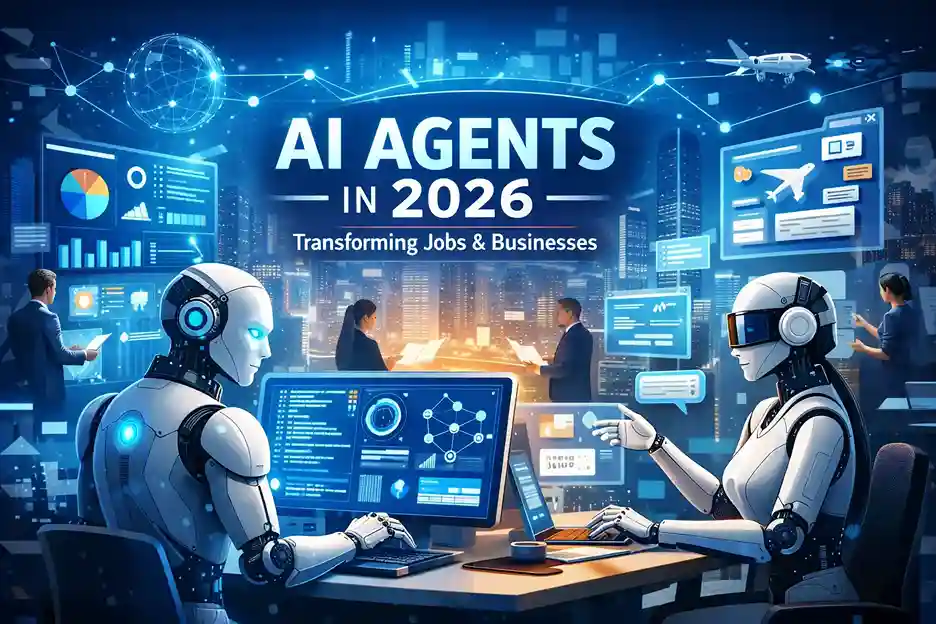
Artificial intelligence is no longer just a support tool. In 2026, AI Agents are becoming autonomous digital workers capable of planning, executing, and optimizing tasks without constant human supervision.
From managing marketing campaigns to writing code and handling customer service, AI Agents in 2026 are reshaping industries globally. Businesses that once relied on large teams are now integrating autonomous AI systems to increase efficiency and reduce operational costs.
But what exactly are AI agents, and how will they impact your career, business, and daily life?
Let’s explore.
What Are AI Agents?
AI agents are advanced autonomous AI systems that can:
- Understand goals
- Break them into tasks
- Use external tools
- Make decisions
- Execute multi-step workflows
- Improve based on feedback
Unlike traditional chatbots, AI agents don’t just respond — they act.
For example:
Instead of asking AI to “write an email,” you can instruct:
“Handle my entire client onboarding process.”
An AI agent can:
- Draft emails
- Schedule meetings
- Generate documents
- Update CRM systems
- Send automated follow-ups
This shift from assistance to autonomy is why AI Agents in 2026 are considered revolutionary. AI agents are the next evolution beyond traditional AI tools in 2026, offering greater autonomy and decision-making capabilities.
Why AI Agents in 2026 Are Trending Worldwide
1. Businesses Want Cost Efficiency
Companies are under pressure to reduce costs. AI automation tools operate 24/7 without salary, sick leave, or downtime.
2. Remote Work Expansion
With teams distributed globally, AI agents help maintain workflow continuity across time zones.
3. Improved AI Infrastructure
Compared to early AI tools in 2023–2024, today’s autonomous AI systems are:
- More reliable
- Faster
- Better integrated
- More secure
4. Competitive Advantage
Businesses adopting AI agents early are seeing higher productivity and improved profit margins.
Real-World Examples of AI Agents Impact on Business
🔹 1. Marketing Automation
AI agents now:
- Conduct keyword research
- Write SEO-optimized blog posts
- Schedule social media
- Analyze campaign performance
- Suggest optimization strategies
Small marketing agencies are scaling faster with fewer team members.
🔹 2. Customer Support
AI agents handle:
- Order tracking
- Refund processing
- Account troubleshooting
- FAQ responses
Many global e-commerce brands report that 60–80% of support tickets are resolved automatically.
🔹 3. Software Development
Developers use AI automation tools to:
- Generate code
- Detect bugs
- Test applications
- Deploy updates
Startups now launch MVPs in weeks instead of months.
🔹 4. Personal Productivity
Executives and professionals use AI agents to:
- Summarize meetings
- Draft reports
- Manage schedules
- Track business KPIs
Many professionals report saving 10+ hours per week.
Future of AI Jobs in 2026
The biggest global question is:
Will AI agents replace jobs?
The reality is balanced.
AI agents are replacing repetitive tasks — not human creativity.
Jobs at Risk:
- Basic data entry
- Routine customer support
- Manual reporting
New Jobs Emerging:
- AI workflow designer
- Prompt engineer
- Automation strategist
- AI ethics consultant
- Human-AI collaboration manager
Just like the internet created digital marketing careers, AI is creating AI-powered professions. Mastering AI automation is quickly becoming one of the high-income skills in 2026 that professionals are learning to stay competitive.
According to the World Economic Forum Future of Jobs Report, AI adoption is expected to significantly reshape global employment trends over the next decade, creating new technology-driven roles while transforming traditional ones.
Risks & Challenges of Autonomous AI Systems
While AI agents in 2026 offer massive benefits, challenges remain.
⚠ Data Privacy
Autonomous systems require access to sensitive data.
⚠ Over-Automation
Businesses must maintain human oversight.
⚠ Ethical Concerns
Governments worldwide are actively working on AI regulations. Governments worldwide are actively drafting policies, as explained in our detailed coverage of global AI regulation 2026.
How to Prepare for the AI Agent Era
To stay competitive:
- Learn AI automation basics
- Improve digital literacy
- Focus on strategic thinking
- Develop problem-solving skills
- Understand AI ethics
Instead of fearing automation, learn to collaborate with AI agents. Beginners can start by exploring practical platforms listed in our guide to useful AI tools in 2026.
The Economic Impact of AI Agents in 2026
Experts predict AI-driven automation could:
- Increase global productivity
- Reduce operational expenses
- Create new trillion-dollar industries
However, workforce reskilling will be essential.
Governments and corporations are investing heavily in AI training programs. A recent McKinsey report on generative AI economic impact estimates that AI-driven automation could contribute trillions of dollars annually to the global economy through productivity gains and innovation.
Final Thoughts: Is AI the Threat or the Opportunity?
AI Agents in 2026 are not just another tech trend — they represent a structural shift in global productivity.
The winners of this era will not be those who resist AI.
They will be those who learn to use it effectively.
The AI revolution is already here.
The question is:
Will you adapt — or fall behind?
📌 Frequently Asked Questions
1. What are AI agents and how do they work in 2026?
AI agents in 2026 are autonomous AI systems designed to complete tasks with minimal human input. Unlike basic chatbots, they can plan multi-step workflows, access external tools, analyze data, and execute decisions independently. These systems use advanced machine learning models and automation frameworks to achieve goals efficiently. Businesses use AI agents for marketing, customer service, operations, and analytics. Their ability to act rather than just respond makes them a major technological breakthrough.
2. How are AI agents different from traditional AI tools?
Traditional AI tools respond to specific commands, such as writing text or answering questions. AI agents, however, can break down objectives into actionable steps and complete entire workflows autonomously. They interact with multiple systems like CRMs, email platforms, and databases. This makes them more powerful and capable of handling complex business operations. In 2026, AI agents represent the evolution from reactive AI to proactive automation.
3. Will AI agents replace human jobs completely?
AI agents are primarily replacing repetitive and rule-based tasks, not creative or strategic roles. While automation reduces the need for manual data entry or basic support functions, it also creates new job categories in AI management and workflow design. Professionals who adapt by learning AI tools can increase productivity rather than lose opportunities. The future of AI jobs focuses on collaboration between humans and machines. Reskilling and digital literacy will be essential in this transition.
4. How can businesses benefit from AI agents in 2026?
Businesses benefit from AI agents through cost reduction, faster task execution, and improved accuracy. These systems operate 24/7, handling customer queries, marketing automation, and operational processes. AI automation tools also provide real-time analytics, helping companies make data-driven decisions. Startups can scale faster with fewer employees. Overall, AI agents improve efficiency and give companies a competitive advantage in global markets.
5. Are AI agents safe and secure to use?
AI agents are generally safe when implemented with proper security measures and monitoring systems. Companies must ensure data privacy compliance and maintain human oversight for sensitive operations. Governments worldwide are introducing AI regulations to address ethical concerns. Security depends on how responsibly the AI systems are deployed. Regular audits and transparent AI policies are essential for safe adoption.
6. How can beginners start learning about AI agents?
Beginners can start by exploring AI automation tools and understanding basic workflow concepts. Online courses, tutorials, and AI communities provide valuable learning resources. Practicing with small automation projects helps build confidence and hands-on experience. Learning prompt engineering and digital productivity tools can also be beneficial. Consistent learning and experimentation are key to staying relevant in the AI-driven future.
By latestnewss.com Editorial Team
Updated 20 Feb 2026